

 Across the buy side, many firms are planning to invest in AI-based approaches, providing further automation and greater insights. But many are discovering the same issue: advanced AI technology can only deliver results if the underlying data is accurate, up to date, and complete. In this regard, investment firms must first make their data fit-for-purpose to take advantage of Generative AI tools utilizing LLMs (large language models).
That’s where a unified Master Data Model (MDM) becomes essential.
The Data Challenge Behind AI and Automation
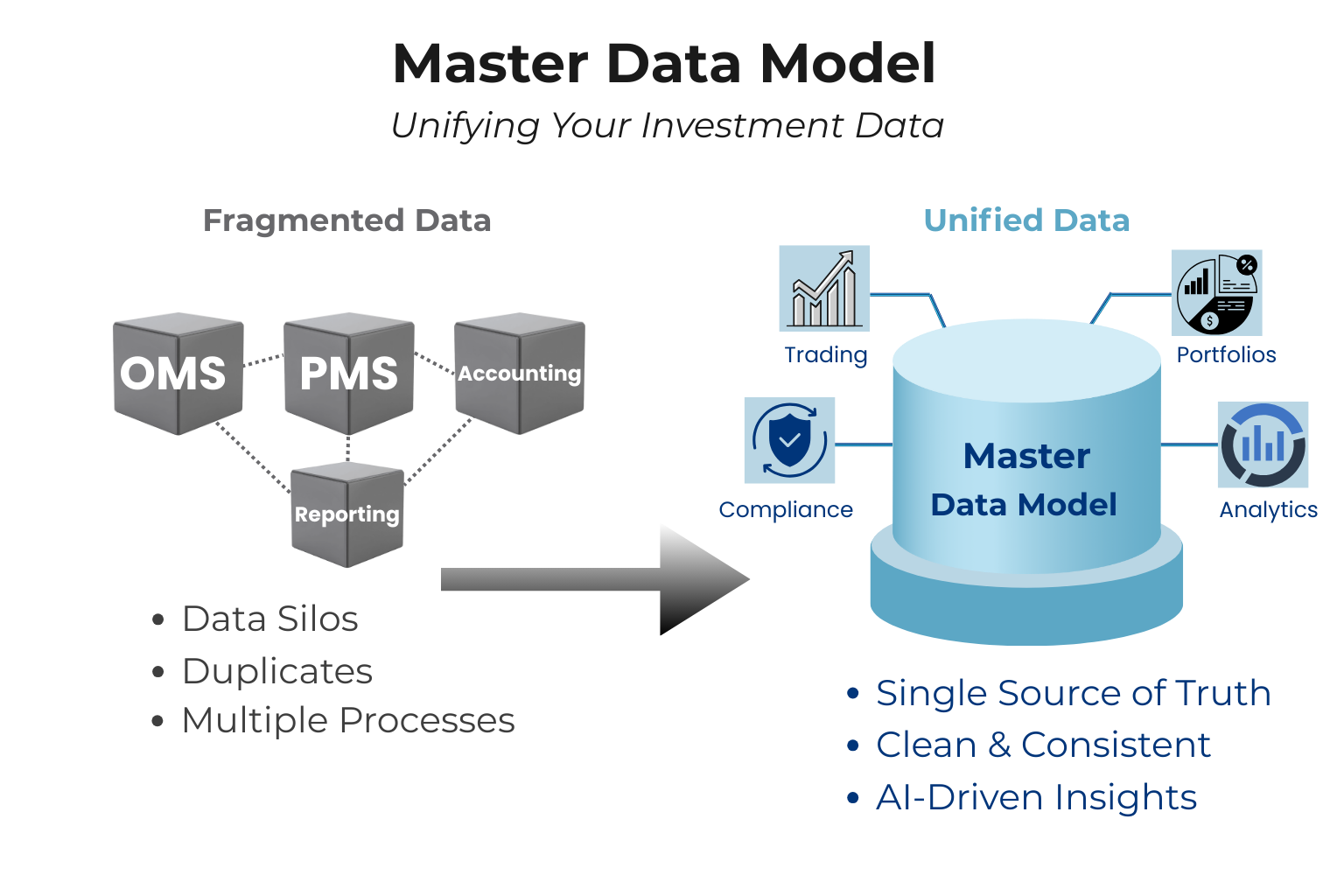
Most investment firms operate with fragmented data architectures. Core investment data is often spread across separate OMS, PMS, accounting, and reporting systems, creating inconsistencies across front, middle, and back-office datasets. Over time, this leads to duplicated data, reconciliation issues, manual workarounds that are Excel-based, and reporting challenges.
AI initiatives struggle to gain traction when data is not unified. LLMs rely on clean, structured, and contextualized data to generate meaningful insights. Without a single source of truth, even the most advanced AI tools are limited in what they can deliver.
What a Master Data Model Actually Does
A Master Data Model creates a standardized data layer that sits across investment workflows. It ensures that the same data is used consistently across trading, portfolio management, compliance, accounting, reporting, and analytics.
Rather than stitching data together downstream, an MDM aligns it at the source. This reduces manual intervention, improves data quality, and enables firms to scale operations without increasing complexity.
Built for Modern Investment Platforms
INDATA’s Master Data Model is designed specifically for investment management environments. It supports multi-asset investment strategies, complex account structures, and evolving product types while maintaining consistency across the investment firm.
Because the MDM is embedded directly into the INDATA platform, data flows seamlessly between OMS, PMS, Accounting and Reporting, and is made available for AI-driven capabilities. This allows firms to move faster, respond to change more easily, and maintain confidence in their data as they grow.
Unlocking AI-Driven Outcomes
AI is only as effective as the data behind it. With a unified Master Data Model, firms can apply generative AI and analytics to accurate and up-to-date information across the organization. This enables more reliable insights, smarter automation, and better decision-making without relying on manual data manipulation.
The result is not just better data, but better outcomes in terms of trading and operational efficiency, as well as client reporting and marketing initiatives.
A Stronger Foundation for the Future
As investment firms modernize their tech stacks, the focus shouldn’t be solely on individual tools or features. The real differentiator is the data foundation that supports everything else.
A unified Master Data Model provides that foundation, allowing firms to fully leverage INDATA cloud-native SaaS platform, AI innovation tools, and scalable reporting, both today and into the future.

