


Launching a new investment strategy has always been complex. Today, it’s also happening in a more competitive and cost-sensitive environment for many investment firms. Market volatility, ongoing fee pressure, and rising operational expenses are forcing investment managers to bring products to market faster, without increasing overhead costs or risk.
Whether firms are introducing new investment strategies related to their core offering, expanding into alternatives, or offering fund strategies in SMA formats for wealth and intermediary channels, success depends heavily on the operating platform behind the strategy. At the center of that platform is the firm’s trade order management system (OMS).
A cloud-native OMS is no longer just a trading tool. It plays a critical role in enabling firms to launch, operate, scale, and report on new strategies with confidence.
Strategy-Specific Workflows Matter
New strategies often introduce new asset classes, execution styles, benchmarks, liquidity profiles, and compliance rules. Firms must be able to demonstrate that they can manage these strategies with reliable, repeatable, and auditable workflows that offer full transparency for investors and consultants.
A modern OMS allows portfolio managers and traders to configure workflows that reflect how a strategy is managed, from order generation and rebalancing logic, to checking pre-trade compliance, then to managing the trade execution process and finishing with post-trade processing. This is especially important for:
- Systematic and model-driven strategies
- Multi-asset portfolios
- Strategies with tight exposure or liquidity constraints
With a cloud-native, API-driven architecture, these workflows can be configured and adapted without costly redevelopment or system workarounds.
Compliance Is Not Optional—Especially for New Products
Regulatory scrutiny tends to be highest when firms introduce new products or enter new distribution channels. Firms must be able to demonstrate pre- and post-trade compliance controls that align with the specific investment mandate.
An integrated OMS/PMS environment enables firms to apply strategy-level compliance rules consistently across portfolios and accounts, whether the strategy is delivered through:
- Commingled funds
- Separately managed accounts
- ETFs
This consistency is critical for scaling new strategies while maintaining governance and minimizing operational risk.
Multi-Asset Support Is Essential
In certain instances, investment strategies do not stay confined to a single asset class. Even traditional equity managers are adding derivatives, currency hedging and overlays, ETFs, and sometimes even alternatives to enhance returns and manage risk.
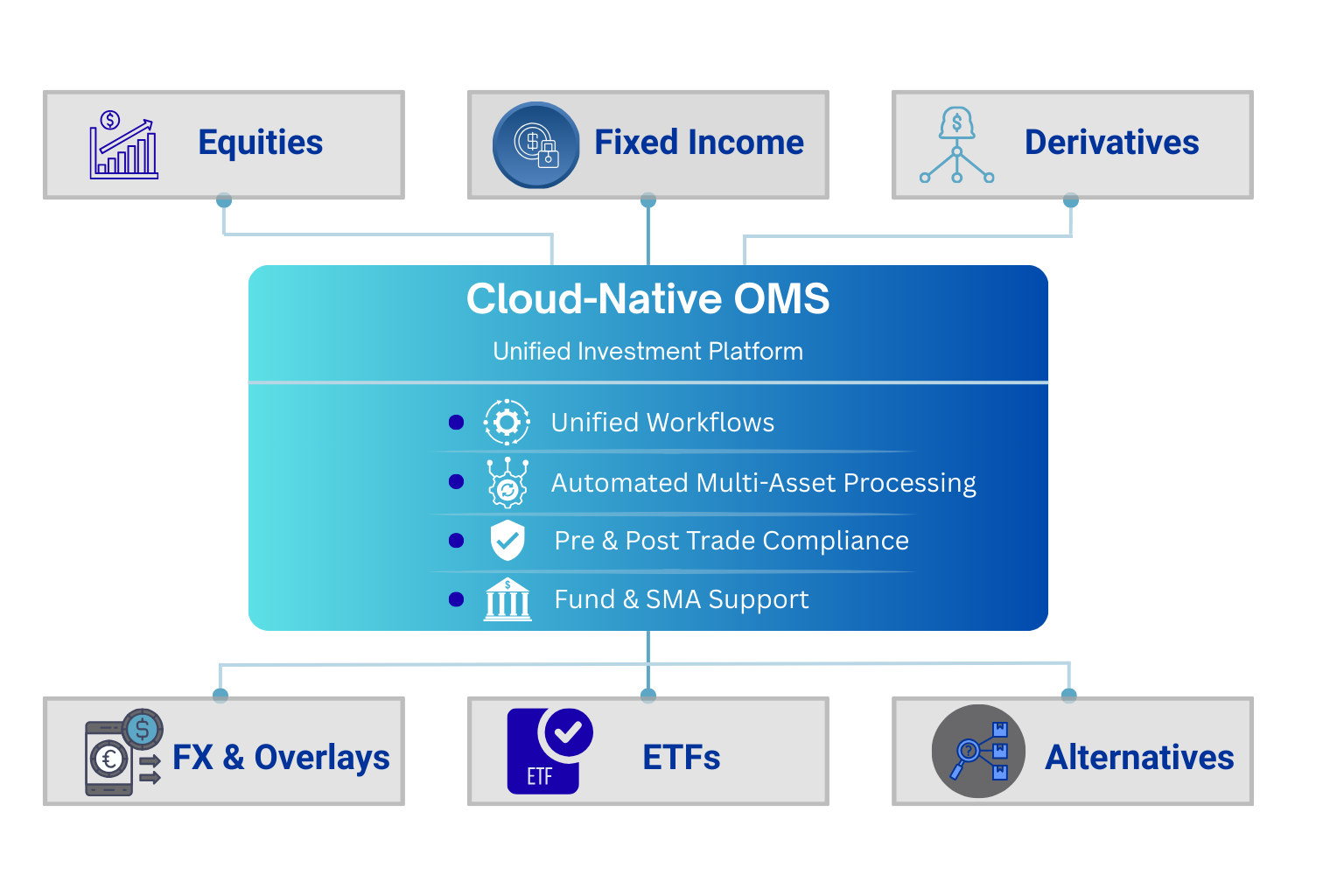
An OMS must be truly multi-asset and instrument-agnostic, capable of handling everything from equities and fixed income to derivatives and complex instruments within a single platform. Automation across these instruments reduces manual processing, lowers error rates, and allows firms to scale volume without scaling headcount.
Fund and SMA Structures Must Coexist
A growing trend in product expansion is offering SMA versions of successful fund strategies. Wealth platforms, model marketplaces, and institutional consultants increasingly demand account-level implementations that mirror fund portfolios.
This creates operational challenges when firms rely on systems that handle fund trading well but struggle with:
- Tax-aware rebalancing
- Account-level restrictions
- Household-level aggregation
A cloud-native OMS that supports both fund and SMA trading models within the same framework allows firms to replicate strategies across structures without duplicating operational processes or introducing new systems.
Reporting Is Key Part of the Product Experience
Launching a strategy is not just about execution; it’s about how results are communicated to investors, consultants, and internal stakeholders.
With an integrated OMS, PMS, and BI reporting layer, firms can produce:
- Strategy-level performance and attribution
- Client-specific reporting for SMA implementations
- Regulatory and operational reporting
At INDATA, Architect AI Reporting and Reporting Pack functionality enable firms to build standardized, reusable report templates while still delivering customized views by client, product, or strategy.
Scaling Strategy Innovation Without Scaling Complexity
As firms continue to expand product offerings in response to shifting investor demand, technology must act as an enabler, not a constraint.
A cloud-native OMS built for investment management allows firms to:
- Launch strategies faster
- Maintain compliance and governance
- Support multiple delivery structures
- Deliver consistent reporting and transparency
In today’s market, firms that can embed innovation into daily operations efficiently are better positioned to compete, grow, and adapt, no matter what strategies come next.
Contact us to request a demo of our cloud-native OMS platform.

