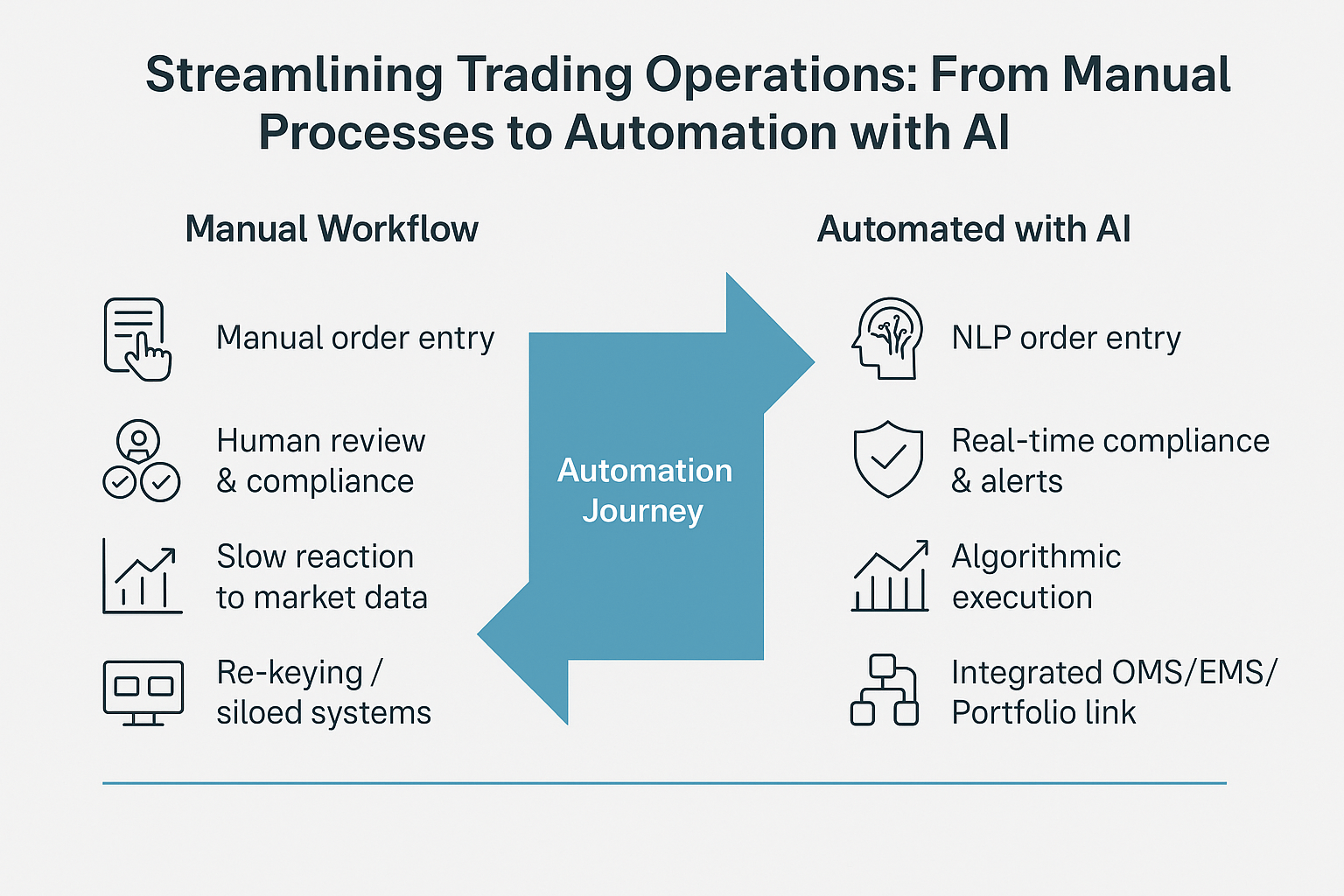
 Buyside trading has many complexities, often caused by manual processes completed outside of trade order and execution management systems (OMS/EMS) and portfolio management. The strains on trading operations from these disjointed workflows are a barrier to modernization and optimization.
Decreasing manual work in the lifecycle of a trade and automating it improves efficiency. It also reduces the risk of human error. Enhancing these processes is also essential for compliance, ensuring the proper controls are in place for clients, consultants and regulatory bodies. The key to achieving best practices is to implement automated trading solutions as much as possible.
By adopting an automated trading system, investment firms can realize benefits that help the entire organization run smoothly. Systems and tech tools powered by AI are quickly becoming a must-have within investment management software. Discover how firms can leverage the latest approaches and the benefits they will bring to the industry as a whole.
Why Automate? The Challenges of Manual Trading Operations
Let’s address the common problems firms face with manual trading. There are several barriers and issues that organizations encounter, including:
- Slower responses to changing market conditions lead to missed opportunities.
- Inefficient workflows prevail as traders have to re-enter data, creating bottlenecks manually.
- Inconsistency arises in performance, often due to emotional bias.
- Any manual work is hard to scale, and capacity limitations may prevent growth.
- Human error risks are common, including mistakes in order entry, data misinterpretation, or a lack of auditability.
Removing these challenges from trading operations becomes more attainable with automated trading.
What is Automated Trading?
Automated trading refers to the use of technology tools embedded within software to create and execute trades. Predetermined conditions drive these activities, applying them against market data.
In this construct, traders establish specific rules for the creation, sending, entry and exit of their trades. The process can occur automatically via algorithmic trading platforms provided by brokers. The rules engine for the given algo(s) guides the behavior of the trade(s) determined by the rules programmed into the system.
The proliferation of automated trading has grown, with some 60-75% of all trades on U.S. stock exchanges falling into this category. Organizations that leverage it can transform their trading operations, with money management firms looking for best execution. All of this starts within an automated trading platform, such as a trade order management OMS or EMS system.
How Does an Automated Trading System Software Work?
The first step is developing automated trading strategies to define the rules and controls. Firms can configure algos based on both simple and complex conditions. Trade order management software then embeds broker-provided algos into end-user screens, enabling traders to adjust the parameters of a given algo. Algos typically take advantage of FIX tags; however, they can also be the result of proprietary methods.
Defining Rule Sets with Guidance and Customization
Automated trading system software also features “wizards” that incorporate technical indicators to guide traders in defining rule sets. Complete customization is also possible. It does require deeper knowledge of the broker’s algo platform and its programming language. This path is more time-intensive but provides more flexibility. The best OMS providers handle these requested specifications for clients as part of their ongoing servicing initiatives.
Automated Trading Starts
Once firms establish their algo “racks,” the automated trading platform is ready for activity. It monitors market data to identify liquidity opportunities that align with the specifications. Algo rule setup determines how the process plays out. Generally, after trade entry, automation also triggers orders for protection, including stop losses, profit targets, or trailing stops.
This next generation of trading can yield many benefits for firms.
The Benefits of Implementing a Modern Trade Order System for Automated Trading
Any time automation becomes part of a process, immediate efficiency benefits become evident. Eliminating manual tasks by traders saves them considerable time. It’s a leading advantage of adopting an innovative OMS/EMS.
Organizations can also mitigate much of the risk associated with human error and enhance their trading strategies.
Increased Efficiency
Algos respond immediately to changes in market conditions. When they locate opportunities based on predefined parameters, they execute trades instantly. This speed of trade execution is not attainable with manual workflows and processes. The human brain can’t track and analyze fast-changing data points efficiently. This is where AI-powered algos have the potential to change the game in today’s algo marketplace.
The added efficiency keeps traders out of busy work so that they can instead focus on the overall trading strategy. They can also optimize execution with the algos, all fueled by AI-powered automation.
Reduced Risk of Human Error
The concern of human error in the trading process has existed from the very beginning. The so-called “fat finger” risk, introduced during the data entry process, propelled OMS and EMS providers to innovate. These vendors focused on more intuitive software, something many continue to pursue.
Now, the rise of trade automation tools powered by AI has the potential to take this a step further, with better-designed systems fueled by more data, leading to even more predictable outcomes. With an AI-based approach applied, a new level of automated trading is possible, further reducing the potential risk of human error.
Enhanced Strategy Execution
When applying automated trading solutions to existing trading strategies, there’s even less delineation from the overall strategy. That’s because the strategy was executed in the rules of the algo in use. The end result is consistent execution, displacing being overly reactive to market adjustments.
Automated trading via algorithms provides a way to backtest individual trading strategies based on historical market data before going live. From this, organizations can better evaluate their own performance based on their unique tactics.
Firms that rely on automated trading system software can also diversify their individual trading approaches. Traders may deploy different strategies simultaneously. This diversification approach has the potential to spread out risk while also protecting against potential losses.
Top Automated Trading Features of an Effective Trade Order System
When comparing trade order systems, prioritize these capabilities:
- Pre-programmed execution: The platform should be able to place and manage orders in alignment with configured rules automatically.
- Algo trading workflows: The solution uses mathematical and statistical models to execute trades at high speed.
- Rule flexibility: Firms want a solution that has options for rule definition to include simple or highly complex scenarios.
- Backtesting: Traders can test automated trading strategies in a controlled environment with historical data. This assesses the viability and weaknesses before they are launched.
- Simultaneous trading: A robust automated trading platform enables multiple trades across various markets at the same time.
- Comprehensive analysis: This functionality employs many indicators and data sources to help users find market trends.
- Risk management automation: This feature incorporates risk controls, including predetermined parameters for take-profit levels or stop-losses.
How AI Is Revolutionizing Trading Processes
AI has fundamentally changed and improved trading processes. When it’s part of an automated trading system, it can deliver advantages in efficiency and precision. Here’s how AI is evolving trading operations.
As AI becomes more deeply intertwined with investment management, it will be significant in further improving trading automation.
AI-based approaches have the potential to “learn” based on data inputs over time, made during the trading process. Deeper analysis with AI-based data analytics and BI Reporting further advances the potential for data-driven insights into trading activities overall.
Another emerging industry trend is the desire for further integration of approaches used in trading strategies with other areas of the investment firm, such as portfolio and risk management. Open APIs (application programming interfaces) will assist in connecting these platforms together for the future.
Natural language processing (NLP), a type of AI, helps trading processes by streamlining complex workflows. The technology can reduce the number of clicks and keystrokes, supporting productivity.
AI drives advanced algo trading. With AI, firms can advance past simple rules-based algos. These algos are also always “learning” based on activity and data. There’s constant optimization happening based on market feedback.
High-frequency trading is another area where AI assists. It can execute trades in milliseconds. With this ability, traders can capitalize on minor price discrepancies.
In the areas of risk and fraud detection, AI can monitor systems in real time to spot anomalies. It may flag issues and send notifications to ensure users investigate further.
Implementing AI Solutions in Trading Workflows
How can firms effectively integrate AI into their trading workflows? It begins with having the right trade management platform that has a proven record of embedding AI into systems.
Organizations should scrutinize AI features to discern whether the tools work as intended. Vendors may cite the use of AI in their solution, but be vague about how it works and its continuous optimization.
Companies should also define their goals around AI usage. These declarations help align objectives to features. Additionally, successful implementation involves minimal friction in connecting the new solutions to existing ones. Data feed integration is integral, as well.
Be sure that providers offer dedicated onboarding and training, so that users are set up for success.
Real-World Applications of Automated Trading
Automated trading has multiple use cases. Here are some examples:
- Trend-following strategies: The automation tool makes trades based on timing, price, and quantity. Algorithm rules can trigger the program to purchase a specific number of shares when there’s an indication of an upward trend.
- Momentum trading: The automated trading system uses a method to predict future values based on previous activity. If prices begin to rise, stock purchases could be initiated until they reach a certain threshold.
- Risk-based: In this model, there is risk-on and risk-off. The automated trading platform may buy higher-risk investments when risk is low, and conversely, it may also sell lower-risk investments when risk is high. The algorithm makes these decisions based on market data, including earnings and macroeconomic indicators.
INDATA’s Advanced Automated Trading Solutions
Firms trust INDATA’s advanced automated trading system. It earns this because of the system’s robust features and ability to customize algos themselves or as a service with a comprehensive list of broker-provided trading algos and liquidity partners.
Comprehensive Trading Platforms
Setting up automated trading is seamless and straightforward within INDATA’s SaaS-based trading solutions. INDATA trade order management includes OMS and EMS. A key workflow aspect is automated trade creation, which leverages AI tools like NLP and machine learning to initiate orders. This accelerates them more quickly and efficiently than traditional methods based on language entries, as opposed to pointing and clicking.
Managed Services
Firms can also partner with INDATA for front-office managed services like setting up and customizing algos and middle- and back-office managed services.
In this arrangement, INDATA experts configure all the requirements for optimizing automated trading within the firm. Organizations can benefit from working with specialists to tailor strategies, reduce costs, and promote efficiency.
Automated Trading with INDATA
Trade more effectively and efficiently with INDATA SaaS-based trading solutions. Firms adopting automated trading have much to gain, advancing data-driven decision-making, improving performance, and reducing risk.
See how the INDATA platform works by requesting a demo.
FAQs – Frequently Asked Questions
What are the main challenges associated with manual trading operations?
The most common issues include slower responses to changing market conditions, inefficient workflows, inconsistency in trade execution, and an inability to scale or add capacity. Throughout all these concerns, the risk of human error is prevalent.
How does AI improve trading operations?
Firms using AI-powered solutions can see improvements across operations. It can learn over time and provide deeper and faster insights. It enhances workflows by reducing manual tasks and automating them using NLP. AI elevates algo trading beyond simple rules-based action. It supports high-frequency trading and can be a tool to identify risk and fraud.
What are the key benefits of automating trade operations with AI?
The top benefits include increased efficiency, fewer human errors, and enhanced strategy execution. The automation workflow capabilities provide these objectives, enabling firms to have a competitive advantage.
How can AI be integrated into existing trading systems?
AI implementation begins with having a robust and agile OMS/EMS that weaves the technology into trade operations. The software could have general AI tracks or the ability to customize them based on specifics. Organizations should evaluate options to determine how AI works within the platform and if it aligns with their goals.
What are examples of successful AI implementation in trading?
Use cases of AI in trading include using algorithm rules to trigger purchases at specific numbers when it detects an upward trend. Momentum trading is another example, which involves purchasing when prices begin to rise to a certain threshold. AI can also initiate buys for higher-risk investments when risk is low.