
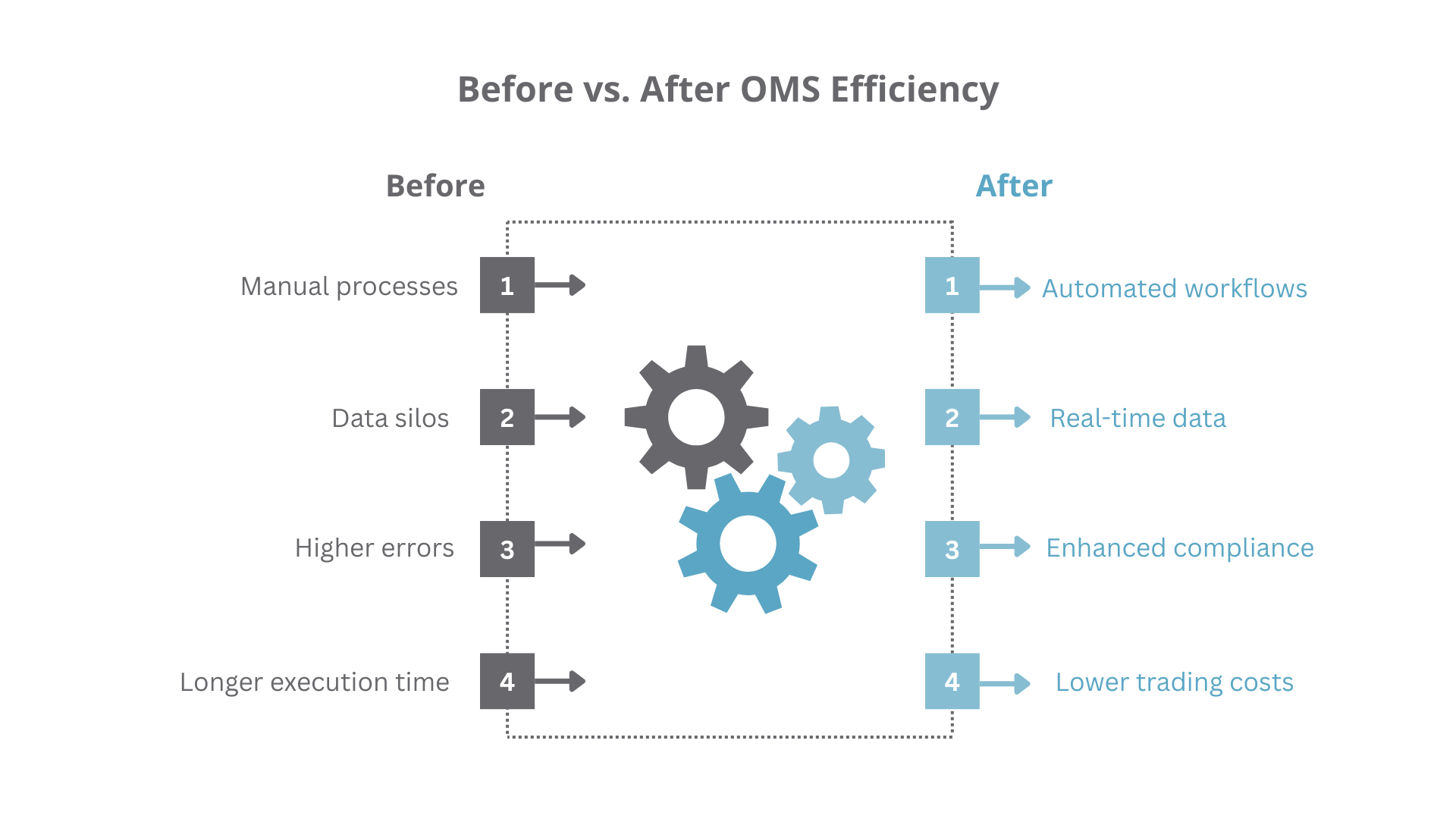
 A trade order management system delivers next-generation technology to the investment environment. Such a platform helps firms realize significant benefits, including closing the gap in trading efficiency.
How does an OMS platform provide such benefits? Robust features that focus on streamlining workflows, reducing errors, ensuring real-time data, and enabling integrations with related systems on the trading desk.
Streamlining Processes and Reducing Errors
Numerous workflows are managed within an OMS. When workflows are disjointed or lack optimization, it’s challenging to manage them effectively.
The leading OMS platforms streamline the entire lifecycle of a trade and connect to upstream and downstream platforms via open APIs. With this capability, users can streamline trade order management, including creating, managing, and executing trades. The result is an acceleration of the process and an improvement in overall efficiency.
These workflows can also benefit from AI to automate processes that don’t require human intervention. Systems can accomplish this by utilizing natural language processing (NLP) and Generative AI through large language models (LLM).
Since AI technology can handle repetitive tasks, firms also see a reduction in errors, which can occur more frequently due to human mistakes. Trade accuracy improves, as well, and some Trade Order Management system software offers a way to customize and configure these to an organization’s specific needs.
Cost Optimization and Compliance
Automated order management can trigger another benefit—cost savings. Firms experience this because it requires fewer staff for manual tasks, allowing those hours to be focused on optimization and strategic work.
As such, faster order processing and minimized errors reflect trading cost efficiencies. In terms of cost optimization, trade order management systems can route orders more effectively to reduce transaction costs.
Compliance standards remain uncompromised. An OMS platform ensures firms meet regulatory requirements. In fact, compliance checks occur in real-time, with access to comprehensive pre-trade and post-trade rules. This must-have feature provides compliance officers with complete visibility into the firm’s trading activities.
Since the solution logs every transaction and reviews all trades for compliance, firms can improve their risk management practices. Intelligent workflows limit operational risk.
Real-Time Data and Integration
No OMS platform would be complete without real-time data availability. Real-time data perfectly aligns with efficiency goals:
- Trading software integrates with market data. As a result, traders have immediate access to the most relevant information to make better decisions faster.
- Real-time data enables faster and more efficient order routing and execution.
- Collaboration improvements occur when all stakeholders have access to real-time information, creating greater transparency.
The integration of real-time data, coupled with automated order management, streamlines the complete trade lifecycle. These attributes in a system also facilitate algorithmic trading, which follows the predefined rules of an organization.
Data becomes more actionable and valuable with the integration of internal and third-party sources. Platforms with open architecture make it easy to link data sources. Integrations within an OMS platform have another benefit: BI reporting. This feature helps users identify greater insights and ensure accurate, timely reporting for data-driven decision-making.
Choosing the Right OMS and Future Trends
How should investment firms evaluate software for trade management and execution? Many considerations guide this decision. Here are key things to seek out in a solution:
- Complete trade order management: Options should include Book of Record (IBOR) AI portfolio modeling: Leveraging AI in these activities ensures a more precise result in a faster timeframe.
- Reporting capabilities: The platform should have solutions for advanced reporting, including BI reporting
- Practical AI applications: For AI to be valuable, firms need tools that work to solve obstacles. In most cases, this applies to complicated or multifaceted workflows.
- Multiple asset classes: An OMS should be suitable for multiple asset classesSaaS-based: Choosing a SaaS platform delivers on efficiency. Updates happen through the cloud and don’t disrupt operations. SaaS is a software distribution model that combines innovation, agility, security, and scalability.
What’s next for trade order management systems? Much of what to expect is drawn from the capabilities of AI and its subcategory, machine learning. Some trends to follow involve predictive analytics and forecasting—the more machine learning algorithms “learn,” the more accurate they’ll be in predicting and forecasting.
- Advanced intelligent automation: The industry can expect further progress, taking on additional tasks, such as order entry, validation, and fraud detection.
- Personalized information delivery: AI can use OMS data to provide customized data output for each end-user, tailoring this approach to a client’s goals and risk tolerance. It fosters better information and potentially leads to greater investment success.
Ready to experience the next generation of OMS? INDATA’s solution is custom-made for any type of investment firm seeking efficiency. Request a demo today.
FAQs – Frequently Asked Questions
What is a Trade Order Management System (TOMS)?
A trade order management system is software that creates, manages, and executes trades. It handles the complete lifecycle, starting with entering the trade through execution, reporting, and compliance. These platforms easily integrate with other tools that investment managers use.
How does a Trade Order Management System improve operational efficiency?
An OMS/EMS enables operational efficiency through automated workflows, reducing manual work and the errors it can present, commencing compliance checks, and integrating real-time data.
What are the key features of a Trade Order Management System?
Capabilities of TOMs include complete trade order management, compliance review, portfolio modeling with AI, advanced trading features, regulatory reporting functions, BI insights, and AI tools that reduce repetitive work.
How can a Trade Order Management System reduce trading errors?
It can automate manual tasks based on rules, reducing human error.
What industries benefit from using a Trade Order Management System?
Multiple financial organizations should have a TOMS, including hedge funds, institutional funds, RIAs, wealth management firms, and assets under management (AUM).