 How can investment firms leverage data to achieve a competitive advantage? The answer is to use finance business intelligence. With so much valuable information, centralizing and analyzing it for decision-making has the potential to revolutionize strategies and improve performance.
What’s been challenging is a mechanism to do this at scale. With the volume of data increasing, most businesses are underutilizing it. A study revealed that 68% of available data is untapped. Connecting the dots to power data-driven decisions becomes the norm when companies employ business intelligence finance tools.
In this article, learn about the role of business intelligence in finance and how companies can take advantage of it to their benefit consistently.
What Is Business Intelligence?
Business intelligence (BI) involves providing the correct information at the proper time to the right people. While it’s a technology for business analysis, it’s different from business analytics (BA).
For BI to work efficiently, the data needs to be accurate, fresh, and complete. In the realm of portfolio management, investment managers can aggregate and integrate data sources, analyzed by AI, to gain greater visibility into multiple areas.
Companies can also use financial business intelligence to streamline their workflow and have the data they need to make informed decisions.
How Does Financial Business Intelligence Work?
BI is essential for financial businesses seeking to spot patterns, track their performance, and make informed financial decisions. BI works by first gathering and then analyzing all of the financial data. It might pull data from different sources, such as:
- Market data
- Internal accounting systems
- Transactions
- Historical data
- Stakeholder information
With all these data points, BI will assist with making data-driven decisions. These sets of information are rapidly changing, which means BI tools must be able to keep pace.
One example of finance and business intelligence is forecasting for budgets. BI can analyze historical financial data, such as sales, transactions, revenue, and expenses.
With all of this information, business intelligence tools for finance create a forecast based on those numbers to aid companies in planning. These models account for the company’s data and consider the historical data of the economy to provide the most accurate picture.
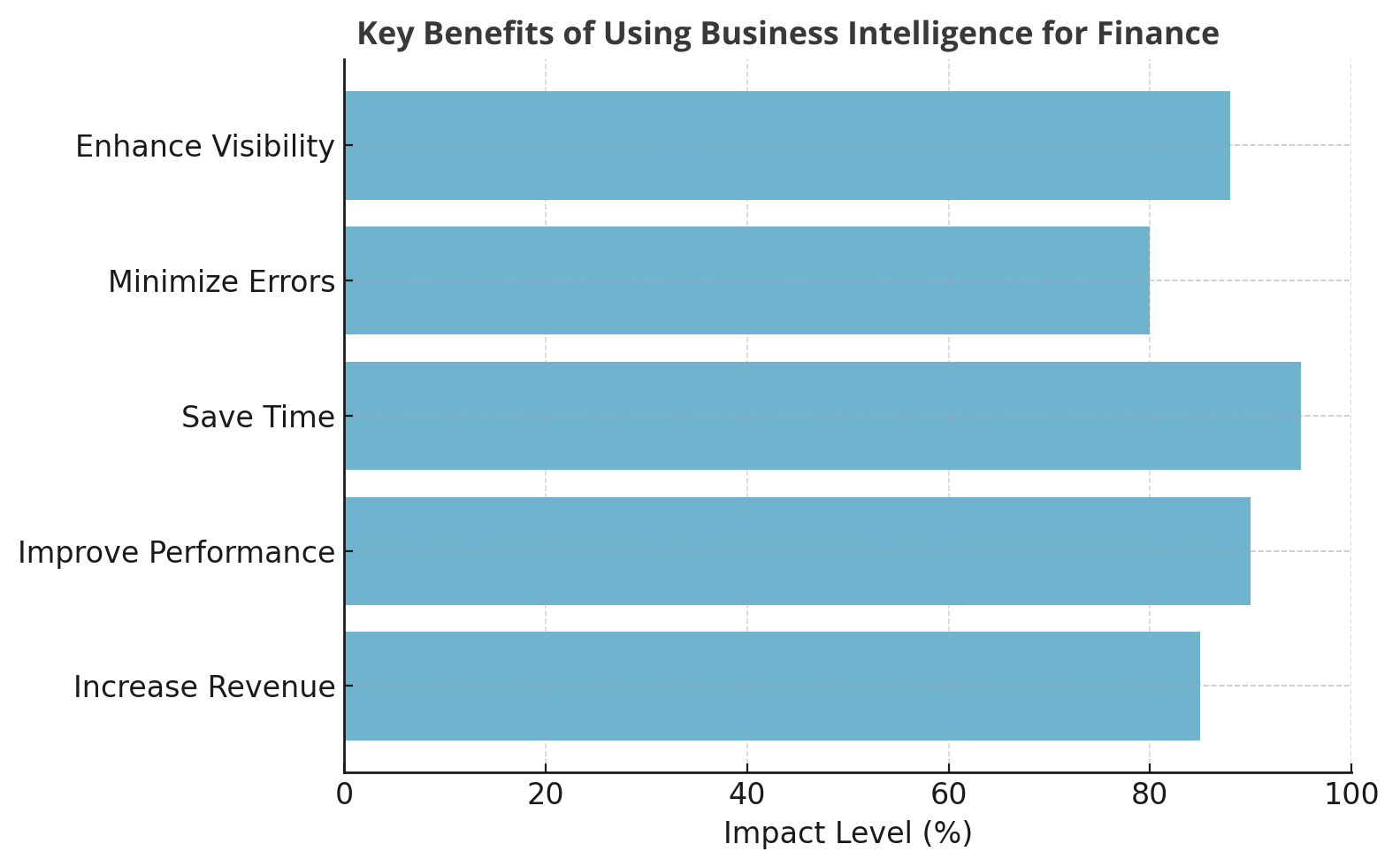
Benefits of Finance Business Intelligence
The role of business intelligence in finance drives many benefits for firms. Fast analysis for making crucial decisions can occur in seconds rather than days.
In a world with so much data, this is one of the main benefits of using business intelligence tools for finance. Other advantages can transform organizations into modern investment firms ready for volatile and unpredictable markets.
Increase Revenue
Sustainable profitability requires retention of clients, and more so than acquiring new ones. However, this has always been a challenge in portfolio management.
Firms can leverage finance business intelligence software to monitor customer retention metrics like repeat customer value, purchase frequency, and attrition rate.
These insights allow portfolio managers to understand why clients stay or go so that they can make accurate financial predictions and forecasts for the future.
Improve Performance
When the financial teams have the most precise and updated information, they can make an informed decision. Finance and business intelligence allow for enhanced budgeting, providing evidence-based advice, identifying areas to reduce costs, and determining where to invest in the business.
Using BI can help financial companies get ahead in the market by using all of this timely information.
Save Time
Financial service companies are drowning in spreadsheets and endless numbers. Combing through and analyzing all of them can be tedious. It’s manual, taking too much time, which can be limiting in a fast-moving industry.
To ease this challenge, business intelligence tools for finance streamline analysis, producing a summary in seconds along with suggestions on how to apply it. Without this burden, teams can focus on making quick, better-informed decisions.
Minimize Errors
Manual work and keeping up with many spreadsheets are situations ripe for mistakes. Excel formulas can break, and one wrong entry skews the entire analysis. When errors occur, if noticed, it takes hours to correct them.
You can eliminate all of this by implementing finance business intelligence software. With this in place, users can trust the validity of the data on a reliable platform.
Enhance Visibility
Even if a company manages its data efficiently, one area that could be lacking is data visibility across the organization.
Many roles within firms need the same access. Having the right BI finance solutions ensures everyone can view the same updated data and results in one centralized location.
Having this solution reduces the risk of an employee looking at outdated data and making a decision based on the wrong numbers.
The Future of Finance Business Intelligence
Big data will continue to grow and become more imperative for businesses, and companies will have more data at their fingertips than ever before. Without the right BI solution, it’s overwhelming.
As the financial market grows more competitive, businesses should consider the value of business intelligence in achieving an advantage. BI will become a necessity for financial services to thrive as more companies continue to harness its power.
To fully apply BI and enjoy all of these benefits, finding the right solution is imperative. The software solutions from INDATA help firms do this. Learn more about how it works and why it’s a leading platform for investment management by scheduling a demo.
FAQs
How can BI tools improve financial decision-making?
Business intelligence finance tools improve decision-making by centralizing and analyzing data from many sources. The analysis provided to firms ensures they can make informed decisions about forecasting, modeling, performance, and client recommendations.
What role does BI play in financial forecasting?
The role of business intelligence in finance forecasting includes leveraging historical company data to identify patterns that would influence future models. A BI tool also considers economic data to mold its output. Additionally, it can support defining potential client churn in forecasting the firm’s future performance.
Can BI help with regulatory compliance?
If using a tool with BI reporting, organizations can also leverage it for compliance requirements. One example is real-time alerts. These notifications can involve noted errors or issues that need immediate attention.
How does BI enhance operational efficiency in finance?
Without finance business intelligence software, firms spend way too much time doing manual work via spreadsheets. It impacts productivity and makes analysis a slow process. BI tools eliminate the need for these things, streamlining all the functions of business intelligence so that everything works smoothly.
What are some common BI tools used in finance?
There are a variety of BI tools that apply to many segments of finance. Some common ones are SAP Business Objects, Microsoft Power BI, and Xledger. Microsoft Power BI is the foundation for INDATA’s platform. It’s fully integrated, enabling users to connect and visualize any data. It’s scalable, as well.