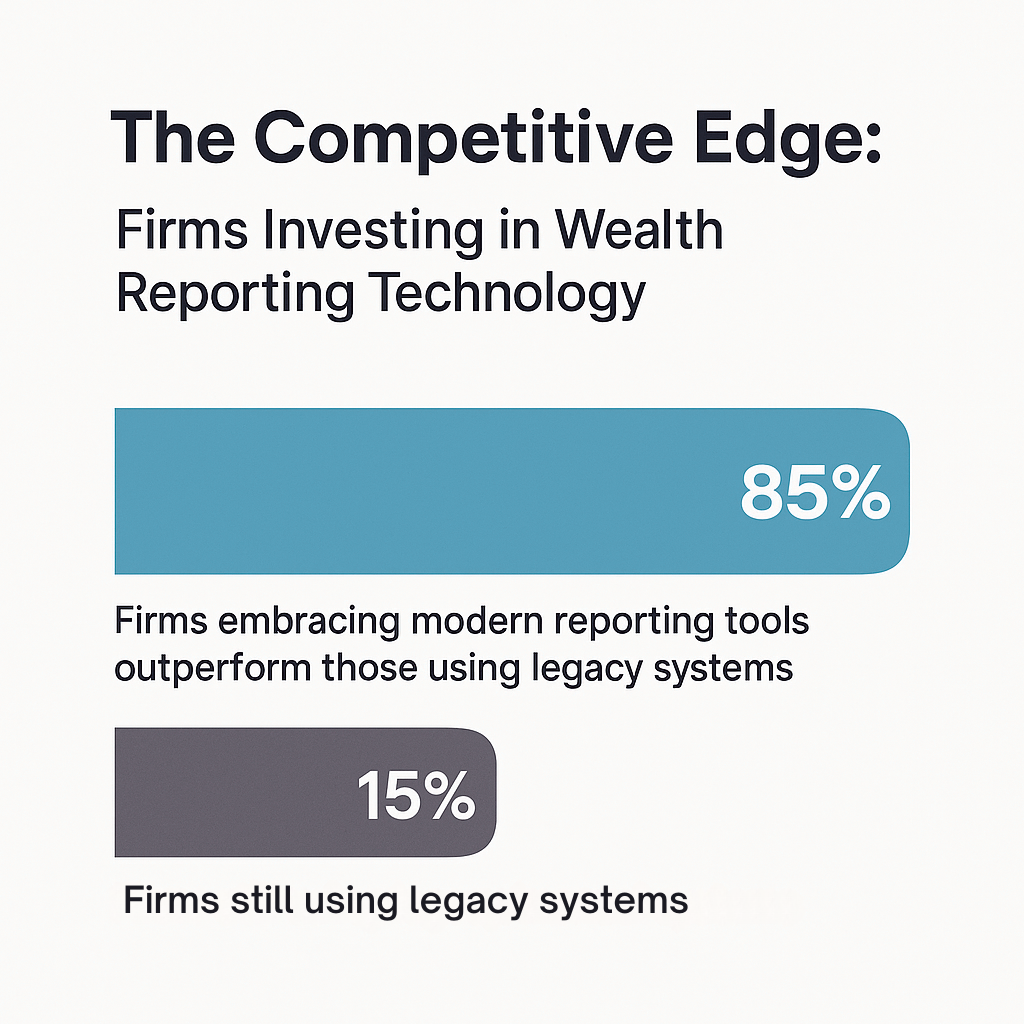
What’s the latest competitive advantage for wealth management firms? It’s the ability to leverage wealth reporting to support personalized performance insights to investors. Strategies for each client are unique, and it can be challenging to customize these.
New technology, like wealth management reporting software, enables this at scale. Implementing solutions like this eliminates the barriers associated with legacy systems and manual workloads of combining and validating data. These platforms also provide a way to create reports that are compelling and visually appealing.
Wealth advisors can deliver and even exceed client expectations while reducing the challenges associated with wealth management reporting within their firms.
The opportunity ahead starts with adopting modern wealth management reporting technology. Its key characteristics include the automation of wealth management data and workflows related to report creation and BI reporting with insights that leverage AI and machine learning tools.
What Is Wealth Management Reporting?
Wealth management reporting describes the creation of investor documentation regarding client investments, rates of return, risk characteristics, and performance analysis.
Most will include the following wealth management analytics elements:
- Account/portfolio information
- Performance summary and details
- Portfolio holdings
- Transactions
- Benchmarks
- Risk measures
- Fees and expenses
These reports have many variations, depending on how a firm can generate them. Advanced reporting capabilities are in high demand in the industry. Most want this functionality as part of their investment management platform. It’s more cost-effective and efficient than the alternative of manually pulling it together from disparate systems. Those applications are typically legacy solutions. Report building also relies on Excel spreadsheets, which require lots of manual work and updating via macros.
Paginated, Print-based Reports vs. Interactive Wealth Reporting
There are two common report types that wealth managers use now — paginated, printed reports and interactive reports based on Excel, PowerPoint, or those available in BI (Business Intelligence) reporting tools.
Traditional Paginated Reporting is Necessary but Has Limitations
Paginated, printed wealth management reports are the traditional outputs most widely in use. They’ve been part of investment reporting from the start. While valuable, they alone are not substantive or flexible enough to have meaningful differentiation. The most common paginated documents are NAV reports, transactions, and client statements.
The main issue with paginated asset manager reporting solutions is their location. They are usually part of legacy wealth management systems that firms or third parties use.
As a result, they are difficult to update or customize. This gap in functionality does not allow wealth management firms to distinguish themselves effectively from one another. In short, they are not able to tell their unique story and value proposition to clients.
Wealth advisors must then turn to other customization options by producing in-house reports based on Excel. The process involves exporting the standard outputs from legacy-based wealth management reporting software into Excel. Then, the manual work of rebuilding these into macros with branding and graphics must occur.
On the surface, leveraging Excel seems cost-effective and easy. However, many challenges arise, including:
- Data quality is often in question.
- Advisors must spend significant time comparing and reconciling the original output to the new Excel macros.
- These manual tasks and processes aren’t scalable, and the more clients and portfolios there are, the greater the workload.
- Using Excel as a reporting tool doesn’t follow best practices from a compliance standpoint.
With such a disjointed workflow, there is a significant risk of delivering inaccurate and untimely information to clients. With these challenges, many firms are seeking to implement modern wealth management reporting software that offers an automated, customizable, and interactive experience.
Interactive Reports Deliver BI Insights
Interactive reports are the newest option. They are increasingly popular with firms as they seek to generate BI reporting. What drives this model is the delivery of information through interactive dashboards. Clients or end users have many customization choices that can capitalize on accurate and up-to-date data.
Wealth managers can then benefit from Excel-like features, but don’t have to worry about scalability. BI Reporting tools have been available for some time now, but most require significant time, resources, and expense to implement and were not designed for wealth management.
These third-party systems require direct integration with the underlying software to create an end-to-end solution. It becomes more complex as a continuous exchange of data is necessary. Additionally, dependence on these platforms creates issues with data integrity and lineage, as well as other data management challenges.
Integrating a standalone BI reporting application most often leads to frustration and sometimes outright failures. It’s highly dependent on the architecture of systems and whether they have open application programming interfaces (APIs) that enable a unified system.
Thus, the industry needs a new strategy to optimize wealth management reporting technology. It must address the factors contributing to changes in the software landscape.
The Trends Driving Change in Performance Reporting for Wealth Management
Savvy firms are tuning into the shifting trends, prompting a change in reporting. Looking at the scope proactively changes what software needs to do.
The factors to consider include:
- Generational preferences are changing: As younger generations begin to grow wealth, the demographic of investors is evolving. So-called digital natives have a greater demand for app-driven access to real-time data. According to a Motley Fool survey, Gen Z and millennials also trade more frequently than older generations. This data point supports their desire for instant and accurate information to be available at their fingertips.
- Transparency is a demand: Investing is highly regulated and surrounded by government oversight. Security and privacy concerns are also factors in terms of compliance. Thus, transparency is a requirement for all clients. This is more readily available with advanced reporting technology geared towards wealth management performance reporting.
- Accuracy is critical to today’s investors: The performance summaries and client statements from decades ago are no longer effective. Current investors expect accuracy and accountability. There’s no feasible way to reach a zero margin of error with paginated and manual, Excel-based reporting.
- Investors have evolving expectations of advisors: A survey on investor-advisor relations found that clients want peace of mind, personalized recommendations, and for managers to understand their goals the most. To deliver this, firms need reliable reporting.
The new era of wealth management reporting meets these needs.
Wealth Management Performance Reporting’s New Era: Integrated
The future of wealth reporting is fully integrated with data management. It should be part of portfolio management and trading software.
In this framework, advisors have a robust data management infrastructure. This is absent from many systems. New technology is in a state of constant flux and needs to keep up by adding new updates and features.
Adopting this path means the hurdles of typical wealth management analytics reporting are no longer. Investors will now be able to build on-demand, custom reports. This new era includes paginated and interactive reports. The result is a blend that enables customization and allows clients to view visualizations based on real-time data.
Some firms may need additional support to streamline reporting. Managed reporting services can alleviate this. Optimizing reporting capabilities isn’t just nice to have. It can be a clear difference for investors.
INDATA Wealth Managing Reporting Software Is the Future
Achieving advanced, integrated, and compelling reporting is possible with INDATA solutions. With Architect AI Reporting, firms can adopt a modern approach to data management, compliance, and BI reporting. It eliminates the complexity and expense of relying on traditional data warehouses. It’s intuitive, robust, and utilizes AI and machine learning for maximum effect.
See how it works by requesting a demo.
FAQs
How do automated reporting solutions improve the wealth management process?
Automation provides a way to streamline reporting workflows, removing the manual work involved in Excel spreadsheets. Faster report generation enables wealth managers to provide insights to clients quickly. The ability to aggregate data from multiple sources ensures accuracy and completeness. It also supports customization of recommendations.
Can wealth management reporting tools be integrated with existing CRM or portfolio management systems?
Yes, the INDATA suite of solutions for wealth management can all integrate for a connected ecosystem. Users gain fully integrated portfolio management software with CRM functions that can also connect to BI reporting tools.
What kind of data is typically included in a wealth management report?
Wealth reporting includes a variety of data points. The most common are account/portfolio information, holdings, performance summaries, transaction records, benchmarks, risk measures, and fees paid.
How can wealth management reporting tools help with client retention?
Clients have expectations that advisors will deliver transparent information with a personalized angle. When firms have robust tools and access to client data to analyze, reporting can deliver on these expectations. Relevant reports that are visually compelling and customized showcase that every client matters, and they aren’t just receiving some generic review.
Are wealth management reports customizable for different client needs?
Yes, every report an advisor generates can be specific to that client based on their preferences, risk tolerance, goals, and previous actions. This data, joined with insights on markets, allows for a report that speaks specifically to that investor.
See how it works by requesting a demo.

David Csiki, INDATA
INDATA provides best-of-class software, technology, and managed services to a wide variety of buy-side clients including asset managers, registered investment advisors, wealth management firms, pension funds, and hedge funds. Find out how INDATA can optimize wealth management performance reporting for your firm.