What’s the key to hedge funds staying competitive? It’s how they access, analyze, and take action with data. It’s become their most valuable asset. However, obstacles and barriers exist that make this challenging. Enter artificial intelligence (AI). Hedge fund AI can drive powerful insights and streamline workflows.
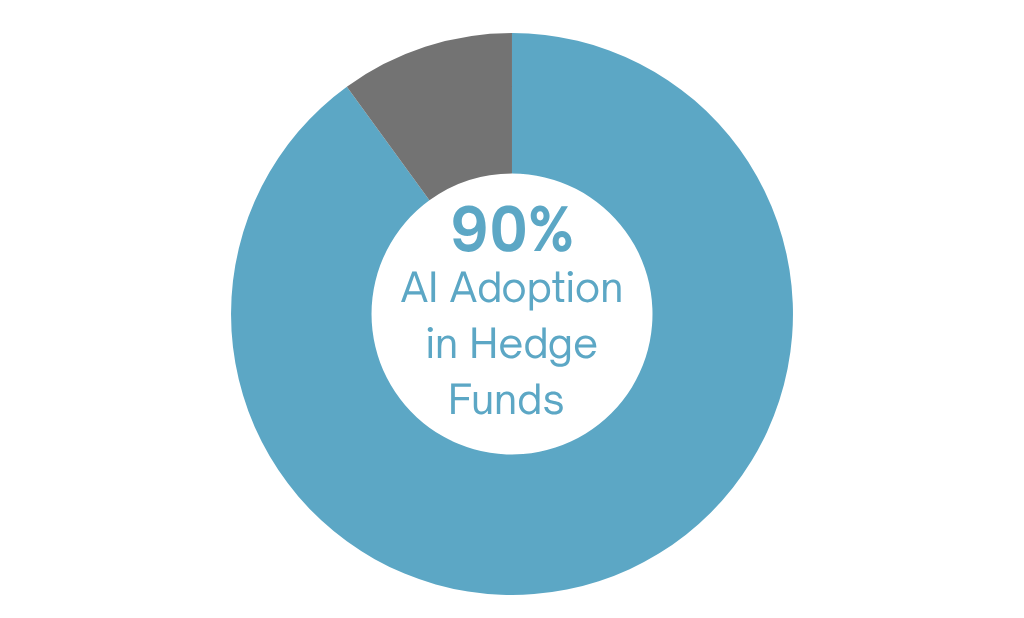
Hedge fund technology has evolved, embedding practical AI into systems, so it’s native and specific to the investment landscape. AI adoption has been rising, with 90% of hedge funds using it to manage investments and optimize portfolios.
The transformative power of AI-based hedge fund technology empowers professionals to identify market trends, analyze data, and develop innovative trading strategies.
So, how does AI work within software for hedge funds? Let’s review all the possibilities.
What Is AI?
AI’s origin story goes back decades, and the father of AI, John McCarthy, coined the term in 1955. McCarthy’s vision was to design a machine that could think and reason like humans. His contribution to modern AI was the development of the Lisp computer language in 1958.
Innovation continued, with timeline highlights of the creation of the first chatbot, robot, and more. The current definition of AI refers to computers that simulate or initiate human behavior through pattern recognition and advanced algorithms.
Businesses and individuals now use AI in some way every day. It can generate content, analyze data, make predictions, offer insights, and draw conclusions.
All of these functions make it a perfect inclusion in hedge fund solution software.
AI Hedge Fund Applications
The headlines of AI tend to focus on its flashiness, but its true value is in the practical. By using AI-enabled technology, hedge funds can apply it in ways that boost efficiency, productivity, and performance.
Key applications for AI-based hedge fund solutions include:
- Predicting corrections
- Analyzing data
- Forecasting market trends
- Forecasting supply and demand imbalances
- Managing risk
- Optimizing portfolios
- Detecting anomalies & fraud
- Automating research
- Executing trades
By leveraging the power of AI, hedge funds gain access to data analytics and predictive algorithms. With these abilities, firms can define and launch the best strategies for investors. Risk management becomes less complex, too, since AI tools scan trades to ensure compliance.
AI’s ability to automate workflows allows firms to eliminate or reduce manual work. With technology taking these actions, there’s also less chance of errors and mistakes.
AI works on more complex and multi-faceted processes within hedge fund technology. This provides more improvements in productivity.
The use of AI by hedge funds relies on several subsets:
- Natural language processing (NLP) is responsible for workflow automation
- Machine learning algorithms, which analyze big data and detect patterns to support decision-making
Challenges of AI in Hedge Funds
While an AI hedge fund solution can be powerful and change the landscape, challenges persist. There are solutions to these with the right strategies and platform.
Data Integrity
One of the biggest hurdles in AI adoption is the quality of the data. If it’s stale, incomplete, or not aggregated, firms encounter barriers. When data lacks integrity, feeding it into an AI engine delivers results that may not be accurate or trustworthy.
Before implementing AI tools, companies must take steps to strengthen data so that it’s reliable, up-to-date, and relevant. Otherwise, it could severely impact the results.
Security Risks
Hedge funds need to be cautious when using AI. With all the incredible productivity it ushers in, there are security risks. The data is often sensitive or protected, which means cyber-criminals find it appealing.
Firms should take steps to strengthen their cybersecurity protocols, following best practices. They should also evaluate how cyber-secure their hedge fund software provider is. Protecting this data is paramount to a company’s reputation. It’s also part of the regulatory requirements in the financial industry.
Lack of Knowledge
AI benefits hedge funds, but it’s still a relatively new technology. Ensuring its usability is critical, and expertise may be in short supply. Firms can counter this by working with professionals in the space who can configure software, train users, and provide support.
Only when AI is practical will users adopt it completely. The solution chosen must be something that’s straightforward to implement.
Benefits of Using AI for Hedge Funds
While challenges remain, the benefits of AI hedge fund capabilities are consequential. When used correctly and responsibly, AI can provide benefits for competitiveness and operational efficiency.
Applications are available throughout the lifecycle of trades, from investment intelligence to automated trading. AI can help hedge funds optimize portfolios and interpret volatile markets, leading to better performance.
Here are some examples of AI-based hedge fund solutions.
Investment Intelligence
Hedge fund investors can use AI-powered technology to identify potentially profitable investments. The algorithms scan data inputs and offer predictions for what the stock will do.
Here’s a scenario. The algorithm identifies a stock going up and sends an alert. Then, the user can act on it.
AI recognizes patterns that happen in the market. For example, it might realize that one stock dips every summer, making it a great time to make a purchase.
With so much data to leverage for action, firms should install investment management software with AI to do this at scale.
Volatility Forecasting
Hedge funds can better manage market volatility by accounting for it. AI hedge fund capabilities enable more accurate predictions to make the best trades.
Understanding these fluctuations can lead to higher returns. Algorithms for machine learning investing are excellent at predicting and recognizing patterns. As a result, the accuracy of predictions improves.
Automated Trading
Another benefit of AI is how it can automate trading. Hedge fund managers can define rules, and those instructions “trigger” AI to make trades. It allows for always-on trading activity, enhances speed and precision, and supports consistency.
Generated Alpha Factors
Hedge funds use alpha to measure fund performance against a benchmark. It indicates the value a hedge fund manager could add or subtract from that portfolio. Since it’s such an important metric, firms must consider all the factors that generate the alpha.
Many different signals show a more significant alpha, but they’re not all equal. With AI for trading, feature engineering is possible. Feature engineering can help managers understand all the risks associated with any underlying aspects that could influence portfolio returns.
With these new features, a higher alpha factor is often the result, informing the trading strategy and making it more effective.
Predicting Market Disruptors
Market disruptions are often unexpected and unprecedented. However, as AI becomes more intelligent, it could even predict events of high uncertainty, helping firms protect investments.
As AI analyzes more data and starts to find patterns and signals in large quantities, it can predict when global events could occur. This technology could become standard for hedge fund management solutions because it is so accurate at predicting events like global pandemics.
AI: The Future of Hedge Fund Management
AI is revolutionizing the investment industry, and the number of funds using it is growing. It can be a powerful tool, but firms must assess all the software for hedge funds that embed AI.
The rise of AI technology in hedge fund management will also enable investors to take more risks. Hedge funds were originally meant to “hedge” the risk of investments by using a mix of different strategies. However, AI can mitigate these risks, making it easier for investors to maximize their returns.
As AI becomes more innovative and better at predicting trades and investment strategies, hedge fund investment firms must leverage it to stay ahead of their competitors.
INDATA has over 20 years of experience offering best-of-class software, technology, and managed services. We work with hedge funds to incorporate AI software that’s easy to use and streamlined. For more information, schedule a free demo with us today.
FAQs
What is an AI hedge fund?
An AI hedge fund describes using AI technology in the trading decisions and management of investments. Firms can use AI in many applications.
How does AI improve data analysis in hedge funds?
Machine learning algorithms have the ability to analyze and predict trends from high volumes of data. It’s much faster than depending solely on human intelligence. It supports data-driven decision-making, which can lead to better performance.
In what ways does AI assist in risk management?
It supports risk management in several ways. First, AI can scan trades looking for anything suspicious or noncompliant. Second, it supports feature engineering, which allows for a full view of associated risks. Third, automation reduces risks related to human error.
Can AI automate trading processes in hedge funds?
Yes, AI can automate trading. Firms set specific rules and instructions. When found, AI makes the trades accordingly.
How does AI contribute to fraud detection in hedge funds?
AI can be a great tool for finding fraud. Algorithms can scan transactions looking for anything that could be potential fraud and bring it to the attention of managers.