
Investment firms are adopting new technologies that bring innovation and automation to their operations. Managing all parts of the trade order and execution management requires access to accurate data and capabilities for compliance, portfolio modeling, advanced trading, and more. The solution —a trade order management system—delivers an efficient workflow that simplifies and consolidates.
While trade order management systems have been part of the tech stack for some time, they are evolving rapidly with features that aggregate multiple data sources and embed practical AI tools. As technology improves, the question of how to best host it becomes even more critical.
Adopting a cloud-based trade order management solution delivers a wealth of benefits. Explore what those are and why the cloud is the future for these platforms.
What Is a Trade Order Management System?
A trade order management system (TOMS) is a software solution that enables investment firms to manage their portfolio holdings, orders, executions, and compliance activities effectively. It offers a centralized approach to these tasks. Automating many manual processes, a TOMS streamlines the entire trade life cycle.
Brokers and traders leverage these to monitor the status of each order as it moves through the system. With this powerful technology, users have complete visibility of the process.
Like any software-as-a-service (SaaS) product, those deploying it can host it in the cloud or on premises. So, why would an organization want to implement the platform in the cloud?
Why Cloud-Based Trade Order Management Software Is the Future
Across all industries, most applications now reside in the cloud. Even the hyper-secure environment of investing has migrated to the cloud as a pillar of digital transformation efforts.
How common is the cloud in financial services? A recent survey found that 87% of organizations have increased cloud spending in the last two years. Additionally, 54% of respondents said they migrated to the cloud and were already seeing ROI in areas of risk management, customer engagement, and data access.
The amount of data required in the trade order lifecycle and the need for it to be available in real-time mean that a cloud-based trade order management system is the present and future.
Big data needs a home. It’s usually not financially or administratively feasible to do this on premises. Hosting SaaS applications on-site requires a company to become technology and security experts, managing servers and equipment with on-site IT needed at all times. It forces investment firms to focus a lot of funds and resources on something that’s not their core competency.
The new norms of work, wherein remote access is essential, have also pushed the transformation to the cloud. Firms also realize that modern architecture is necessary for their tech stack, ensuring it can scale and adapt as their needs do, which also makes the cloud the ideal fit for the industry.
How Secure Is the Cloud?
Concerns about moving to the cloud are still top of mind. After all, the data that’s so critical to trade order management is personal and confidential. Rigid security protocols are a given, but today’s future-proofed cloud environment is ultra-secure and reliable.
Today’s cloud has layers of security. Software companies bear the onus of protection and use the most advanced and sophisticated cybersecurity protocols. Those include firewalls, intrusion prevention systems, network segmentation, and constant vulnerability scanning. A fortified cloud has all the security and compliance requirements any firm would need.
Next, let’s review all the benefits of trade order management systems in the cloud.
Benefits of Using Cloud Trade Order Management Software
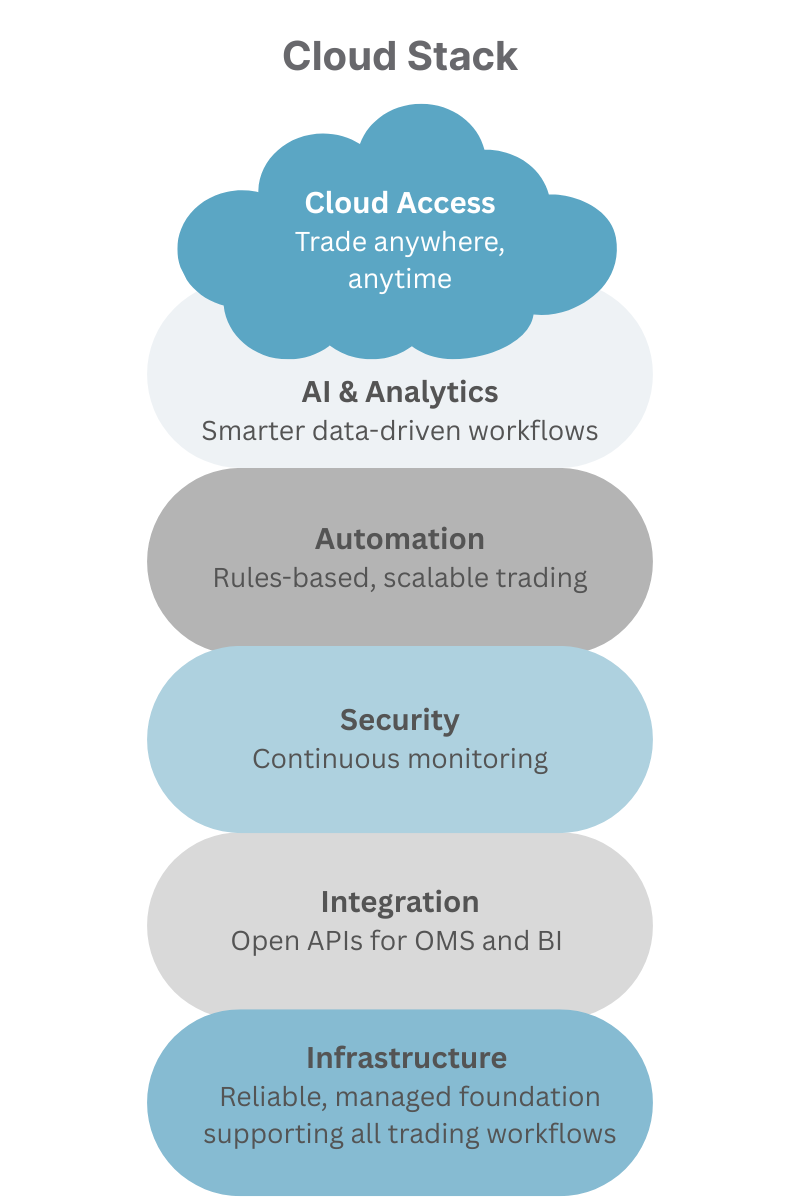 What can firms gain when they use the cloud for trade order management systems? These solutions are necessary for successful operation. Here are the top benefits of why businesses should deploy a cloud-based system.
Increase Efficiency and Accuracy
Manually updating various data points is too time-intensive and prone to human error. They slow down productivity and the ability to meet timelines. This comes with the risk of overselling if the inventory is not accurate.
Within a cloud-based trade order management system, an automatic link to all channels exists. As a result, users have this information in real time. This functionality ensures traders have the most up-to-date inventory, leading to faster turnarounds without the risk of mistakes. Efficiency and accuracy advantages also directly impact client relationships.
This framework works best in the cloud, so that data feeding into the software is constant and not susceptible to downtime or other technical issues that can occur if hosted on-site.
Access and Derive Insights From Real-Time Market Data
Every firm wants a competitive edge on insights, and the cloud makes that possible. A cloud-based trade order management system allows asset managers to see real-time market data. Traditional trading platforms don’t enable this, which affects business decisions. When it’s available, decision-making is more adept, as users can respond to market changes.
This real-time analysis is part of cloud trade order management software and helps identify profitable trades and make strategy adjustments. The newest addition to this aspect of trading is the embedding of AI tools. With these practical features, insights are quicker, allowing for even better decision-making.
Enhance Scalability and Flexibility
Another advantage of the cloud is scalability. As trading operations grow, the cloud adjusts to new needs without concerns over downtime and setup that are typical with on-site installations.
There can be peaks and valleys in terms of activity, and the cloud can scale up or down as required without any action taken by IT. Scale gives firms an assurance of reliability, no matter the usage.
Ensure Access from Anywhere
The cloud enables access to the system from anywhere. Employees don’t have to be in the office to initiate trades. It provides flexibility, which is good for investment managers and their clients.
It may also be a way to expand a firm’s talent pool, providing the ability to hire remote workers. Setting them up with a cloud-based solution means they have the same tools as anyone working in an office.
Reduce IT Costs
Investment firms, like any other business, strive to reduce expenses whenever possible to enhance profitability. IT costs have only grown as companies use more applications and need the infrastructure to support them. On-premises hosting has considerable expenditures, including:
- Servers and equipment
- Energy costs
- Labor for support and upgrades
- Cybersecurity tools
These costs will only continue to increase, but moving to the cloud reduces exposure. By moving to the cloud, organizations eliminate these expenses. Cloud companies are responsible for the expenses related to infrastructure, security, and software updates.
Firms also no longer need the space to hold all the equipment, leading to savings on energy costs. They may even be able to decrease their square footage, saving money on rent.
With cloud-based platforms, companies can reduce their budgets, transitioning from CAPEX to OPEX spending. Being able to leverage the cloud expertise of the software provider via back-office managed services further moves ownership and costs away from a company’s budget.
Strengthen Security and Reliability
Any cloud-based trade order and execution management platform must be secure and reliable. Typically, clouds have multiple layers of security to protect data. Additionally, the software always runs the latest version to mitigate any risks associated with using older versions.
Reliability in a system means it has lots of safety nets for redundancy. Data always has at least one complete backup. Having these mirrored servers separate from those in use is vital in today’s world of constant cyberattacks and ransomware. This capability enables companies to keep their systems running in the event of an incident. It’s the most comprehensive way to ensure business continuity.
The Challenges of Manual Trading Operations
Any firm that still depends on manual operations around trade and execution faces many issues. It requires constant attention, which means productivity falters and burnout can increase.
Financial markets are always active in some places in the world, so manual trading must involve monitoring at all times, so there’s no missing out on price movements. Extensive research also contributes to making the best trade decisions. If required, the sheer volume of information is simply too much to keep up with, no matter how industrious the trader.
Along with missing things, manual work leads to higher risks of mistakes, such as transposing a number or forgetting a decimal point. It’s such a minor error, but it could have considerable consequences.
Manual processes keep firms from achieving operational efficiency and growth. The cloud empowers the industry to eliminate much of this in the next generation of trade management software.
Seamless Integration with Existing Systems
Cloud-based solutions for trade order management deliver another advantage. Because their architecture is modern and lacks the barriers of legacy systems, integrations are much easier.
An integrated ecosystem of a tech stack for investment firms provides efficiency and visibility not found when everything operates in siloes. What typically makes this possible is open APIs. When software has these capabilities, integrations are much smoother.
The most sought-after integrations for trade order management include:
- Business intelligence reporting: Accurate and timely reporting supports data-driven decision-making.
- AI tools: Systems run leaner and smarter when AI is part of the ecosystem.
- Electronic Communication Networks (ECNs): Integrating with these applications supports order aggregation, best price matching, order book visibility, and trade execution.
- Alternative Trading Systems (ATSs): This connection of systems creates streamlined, efficient trading workflows for buy- and sell-side firms.
- Execution management systems (EMS): An EMS and OMS can be part of the same platform. They can also operate separately but integrate to ensure all order and execution capabilities sync.
Ready to Explore Cloud-Based Trading Order Management Systems?
The benefits of the cloud are clear, and firms that want to future-proof their operations are turning to the cloud. With a cloud-based order management platform like INDATA’s iPM Portfolio Architect AI, investment managers are more efficient, data-driven, effective, and productive.
Learn more about what iPM Portfolio Architect AI offers by requesting a demo.
FAQs – Frequently Asked Questions
How does cloud-based TOMS enhance scalability?
The cloud enables scalability by providing on-demand and flexible access that can instantly scale up or down to meet workloads. As platforms become more sophisticated with additional features and data aggregation capabilities increasing, having a scalable solution is necessary for reliable performance.
What security features are included in cloud-based TOMS?
Security functionality varies depending on the type of cloud: public, private, or hybrid. In general, cloud security includes identity and access management (IAM), which controls user access, data encryption while at rest and in transit, and network security tools like intrusion prevention systems and firewalls. Clouds can also have threat detection monitoring, which constantly scans traffic to applications.
Can cloud-based TOMS integrate with existing trading platforms?
Yes, a TOMS with open APIs and modern architecture can integrate with a host of other solutions, including ECNs, ATSs, EMS, business intelligence systems, and more.
What are the cost benefits of adopting a cloud-based TOMS?
Once firms move to the cloud, they can remove capital expenditures from their budgets, such as servers, hardware, and equipment. They may also be able to reduce costs associated with on-site IT professionals. Another area where savings may apply would be on energy costs, as these can be very high since server rooms must remain cool and dry. Finally, they’ll no longer need the space for these things, so that they can decrease their physical footprint and the costs associated with it.
Can small or mid-sized firms benefit from cloud-based TOMS?
Yes, any-sized firms can benefit from a cloud-based trade order management solution. The cost to deploy the software is reasonable, and they won’t need experts in cloud computing or security, as they’ll have that in the partners they choose.