


Future Proofing the Front Office: AI Technology
Part 3 of a 3-part series on Future-Proofing the Front Office. Want to download the full Whitepaper directly? Get it here!
From a technology perspective, artificial intelligence (AI) seems to dominate every conversation. AI technology has ushered in a new age of innovation, one that’s practical and accessible.
ChatGPT and other generative AI tools have become something people use every day at work and in their personal lives. There is now the expectation that AI use cases apply to every industry, including investment management. There are both benefits and risks, as is the case with any technology.
Will AI replace people? Will its disruption eventually lead to negative and positive outcomes? Should firms adopt it or wait and see?
These “big” questions are part of discussions today. AI has arrived, and it’s here to stay. Investment firms have the opportunity to use it for a variety of functions. It can augment human intelligence but doesn’t replace it.
AI has practical implications for the entire investment firm, from front to back office. Before embarking on an AI strategy, buy-side firms should understand AI, how it started, and its evolution. With this knowledge, firms can make the best decisions about the future of AI in business.
The Business of AI
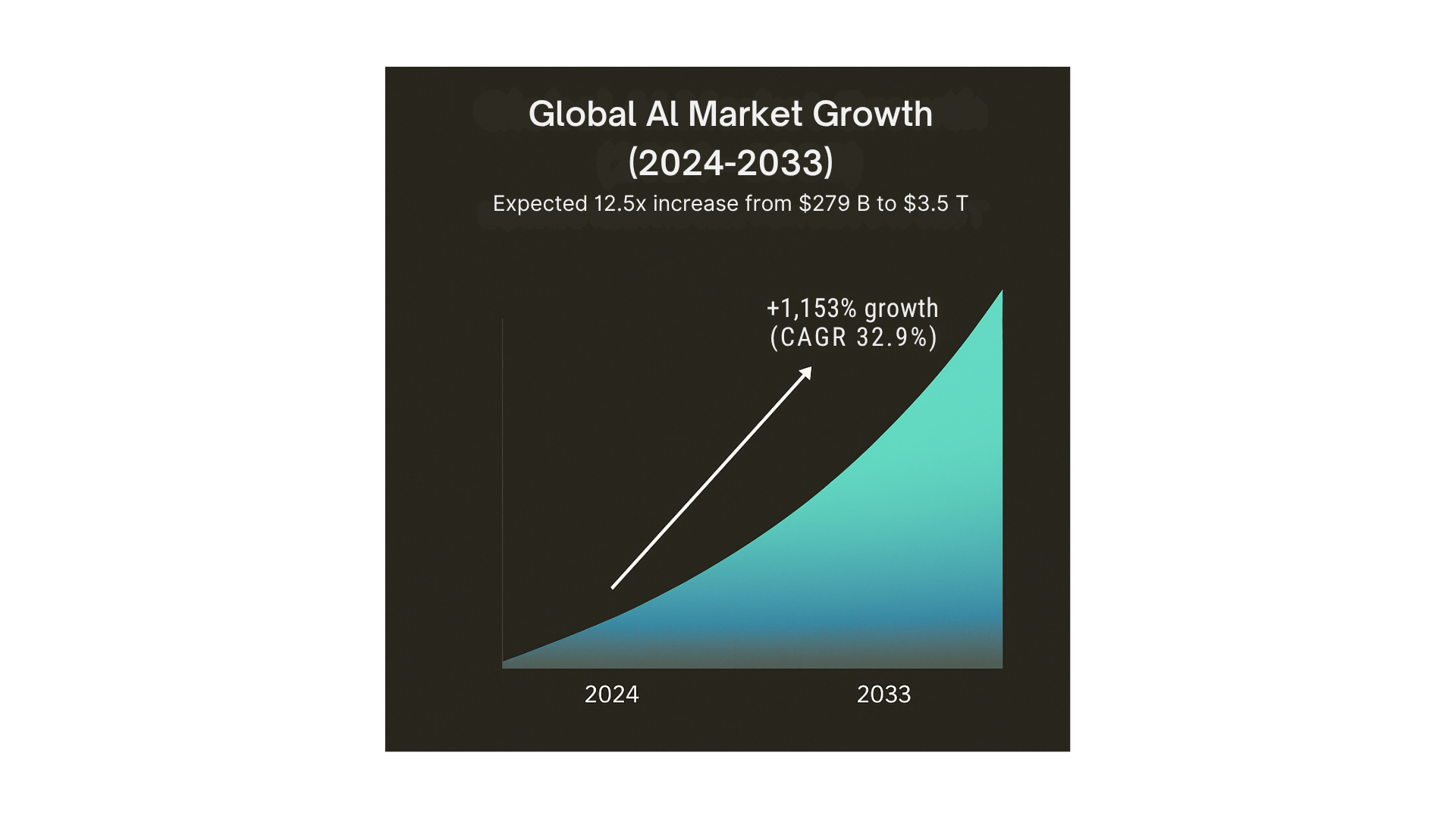 Separating fact from fiction is critical for the buy-side front office when it comes to the topic of AI. From a global view, the AI market had a value of $279.22 billion in 2024, with an expectation to reach $3,497.26 billion in 2033.
Think of all the ways the average person uses AI today—internet searches, asking Siri a question, or viewing recommended products online.
From a global view, the AI market had a value of $279.22 billion in 2024, with an expectation to reach $3,497.26 billion in 2033.
Think of all the ways the average person uses AI today—internet searches, asking Siri a question, or viewing recommended products online.
What is AI Technology?
Defining AI may seem broad and overly technical. Let’s simplify it. It was coined back in 1955 at an industry conference by John McCarthy. McCarthy is often called the “Father of AI,” and he developed many of the foundational concepts that continue today.
In short, AI is the ability for computers or machines to simulate or initiate human behavior through pattern recognition and advanced algorithms.
While a broad definition, it’s an excellent basis for a conversation that explores how to use AI in investment management. To expand on it further, AI is a general umbrella that contains a variety of subfields, including machine learning, deep learning, natural language processing (NLP), and robotic process automation (RPA), among others.
Avoiding a deep dive into the distinction between proven and emerging technologies, it’s safe to say that all subfields of AI share a common goal – to design computer programs that exhibit behavior considered “intelligent” by human standards. These technologies are “smart,” as they process information like the human brain.
As a result, these AI-powered systems can effectively work with a specific set of data, analyze historical and current trends, draw meaningful conclusions, make informed suggestions, and deliver valuable insights, all seemingly automatically. This brings a level of operational efficiency and intelligence to various processes within your business operations.
AI vs. Machine Learning
So what is the difference between AI and machine learning? Machine learning is a subfield of AI and one of its primary building blocks.
To understand the practical application of machine learning and AI, let’s use a common example of e-commerce. Customers use a site’s search engine to find products. This provides valuable information that updates the company’s data model. Machine learning algorithms analyze these search patterns, comparing customer searches and choices to available inventory.
Through these AI-based algorithms, retailers can then deliver relevant recommendations to shoppers, offering a more streamlined and personalized shopping experience.
Machine learning leverages algorithms to help make comparisons. How does this relate to using AI in investment firms?
On the buy side, algorithmic trading (algos) has been around for a long time within applications that execute trades like OMS and EMS applications. From that perspective, firms are probably already leveraging machine learning.
While brokers are extensively using machine learning (algos) for front-office investment management solutions, they haven’t moved into areas beyond trading. Machine learning has the potential to make other front office areas more efficient in terms of investment decision-making, compliance, and client-facing functions.
The opportunities are wide-ranging. However, as with anything related to investing, it all depends on the data, and this is where the challenge lies.
Generative AI vs. Machine Learning
Generative AI is another subfield of the technology. It works by users inputting prompts and then generating something—text, images, audio, or video. ChatGPT is an example of generative AI.
Machine learning’s purpose is to learn from data and make predictions or decisions. They are very different but are still part of the same AI umbrella.
Machine Learning vs. Deep Learning
Deep learning may be the most overly hyped aspect of AI in investment decision-making. It seeks to imitate the workings of the human brain in processing data and creating patterns for use in decision-making. The goal is accurate predictive analytics, the holy grail of AI in investment management—and in every other industry as well.
Deep learning is a subset of machine learning that has networks capable of unsupervised learning from unstructured or unlabeled data. It is also known as neural learning or neural networks.
The challenge with deep learning in investment decision-making includes:
- Extreme variability from one investment strategy to another
- The availability of data, which exists both in structured or relational databases, vs. unstructured sources that exist out there in the world, in terms of the internet, social media, etc.
Big data analytics offers a way to aggregate wide-ranging data types into models that can be applied to deep learning methods. However, to put it bluntly, this type of AI technology approach is experimental at best. In other words, deep learning is primarily a solution looking for a problem(s) to solve rather than vice versa within the world of the buy-side front office.
That’s not to say that deep learning doesn’t have tremendous promise for the industry. On the contrary, however, in its current evolution, it’s not a proven solution that wealth managers can confidently use to get results. Instead, NLP, another subfield of AI, has the potential to improve front-office investment management operations.
Natural Language Processing (NLP)
Like machine learning, NLP has been around for a while. Large tech providers, including Google, Amazon, Apple, and Microsoft, pioneered it.
As mentioned earlier, performing a Google search employs natural language AI. So does Siri on an iPhone and Alexa in the home. Consumers actively use them every day.
Adam Cheyer, the co-founder of Siri, which was sold to Apple, said, “AI will be the next User Interface.” As a result, it will be as important to the future as the web and mobile have been.
The crux of natural language AI is having a conversational interaction with software using a digital assistant. NLP has the power to reduce endless amounts of pointing and clicking, repetitive processes, and inefficient workflows based on workarounds and spreadsheets. The resulting operational efficiencies from streamlining time-consuming processes can save endless hours across the front office for portfolio managers, compliance officers, traders, and all of their support staff.
This example perhaps best explains the potential for NLP to reshape the buy-side front office. AI for investment management, specifically designed to solve a firm’s problems, helps the business gain a competitive advantage.
Front office systems are ripe for AI technology like NLP. Too often, front office OMS/PMS systems are overly complicated with too many clicks, screens, and workarounds for any given process. And in doing so, the platforms have lost their core tenet of automating manual processes for the sake of being an all-in-one solution.
Alternatively, the fastest way to get from point A to point B is a straight line. Natural language processing is the practical AI tech that can make that happen.
Other AI technologies, like RPA, are also worth evaluating for certain functions. However, because the front office is very much a people’s business, it will remain that way for the foreseeable future. Robots (or more precisely, robotic programs) will not replace people; however, the practical AI technologies discussed can make people more efficient and help them do their jobs faster, with fewer people and with higher accuracy.
In truth, this should be the overarching goal when evaluating the benefits of AI in business.
Uses of AI in Business for Investment Management Firms
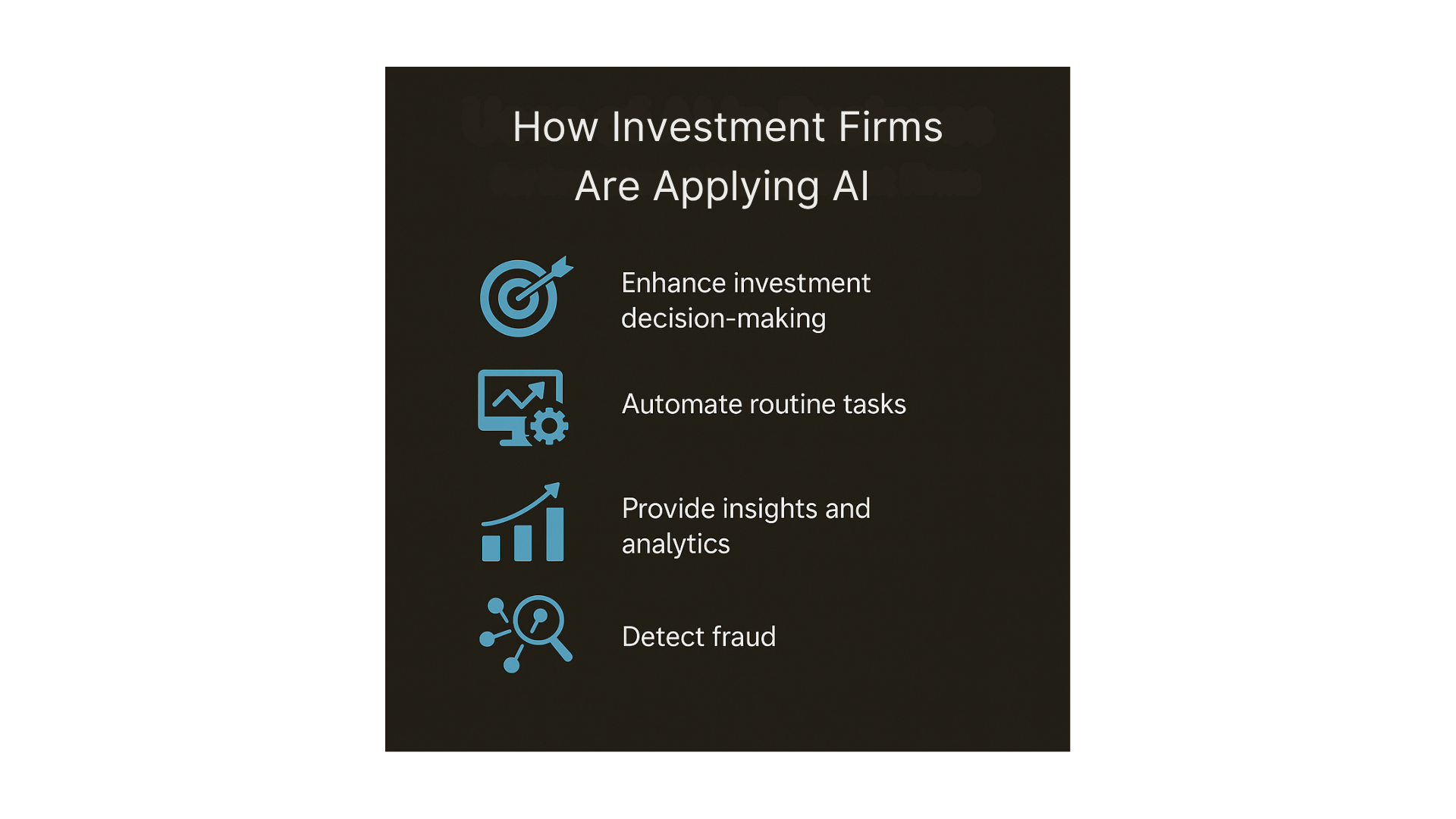 A recent industry survey found that 73% of wealth managers see AI as the most transformational technology shaping the industry.
Many firms have already invested time and energy into streamlining their front office systems, reaping the benefits. For companies that have not yet begun harnessing the power of AI, failing to do so may mean being left in the past.
Here’s what AI can do for investment firms.
Leveraging New Data Sources
There are more data sources available than ever before. The challenge is that combing through the data and analyzing it is a monumental task. However, by using AI-based algorithms to interpret this data, firms can save countless hours and gain value from access to wider datasets.
Stronger Forecasting
The buy side thrives on having strong intelligence. Data sources can now draw on world events, ESG considerations, past decision-making, and choices. Using AI and ML can deliver better forecasting to empower stronger, data-driven trading recommendations.
Deeper Degree of Personalization
By predicting client questions and enabling stronger virtual conversations, AI can power improved customer service. Additionally, AI can streamline the buyer journey so customers get the most relevant information possible based on their past and current interactions. To that end, AI can watch for specific behaviors, help users overcome potential objections, and move prospects down the funnel faster.
Client Retention
Following the same logic as personalization, AI can use predictive modeling to identify signs that a client may be considering alternative investment firms. Based on those set behaviors or phrases, one can continue to improve their relationship with clients, whether through automated CRM actions or by triggering a flag to reach out directly.
Compliance Monitoring
In addition to supporting buy-side trading and portfolio management decision-making, AI can enable firms to monitor transactions for suspicious activity. In doing so, it involves identifying potentially problematic transactions and heading them off before they happen. This capability saves compliance teams time and energy, freeing them up to focus on the most critical items for the firm at a given time.
These uses of AI in business don’t encompass the full potential of the technology for investment management firms. They do help to consider some of the broad opportunities.
The Future of AI in Business: Investment Management is Bright
AI can now yield tangible possibilities and considerable competitive advantage. It analyzes large data sets and market trends to deliver key insights for portfolio managers while simplifying trading and operations.
The buy-side front office developed software to automate workflows for portfolio managers, traders, compliance, and their support staff over the past 20 years. AI will reshape front office operations going forward. Firms should look beyond the hype. Instead, focus on how practical aspects of AI for investment management can help businesses become more efficient, contain or reduce costs, and improve competitiveness.
The reality is that the benefits of AI in business are possible through the widespread use of the cloud and data analytics powered by APIs. These vital and interconnected technologies have a very significant role to play in the future of the buy-side front office.
As is the case in racing, for traders and portfolio managers, seconds matter. AI-powered software will become the norm on the buy side, and early adopters will pass their slower competitors who risk becoming permanent lap traffic.
INDATA harnesses the power of artificial intelligence for investment management to streamline workflows, improve productivity, and deliver industry-leading solutions for firms ready to gain a competitive advantage. Schedule a demo today.
FAQs
What is AI technology in the context of investment management?
AI technology is the ability for computers or machines to simulate or initiate human behavior through pattern recognition and advanced algorithms. For investment management specifically, it’s using AI-enabled investment management software that supports automation, data analytics, predictive analytics, monitoring for anomalies, and personalization.
How can AI improve data analysis in the front office?
The amount of data that the front office has at its disposal grows every day. It can be in a variety of formats and come from many sources. AI can aggregate it, standardize it, and then analyze it for insights. Machine learning algorithms scan the data for patterns and trends that they deliver to investment managers so they can make better decisions.
What tasks can AI automate in the front office?
AI can automate a variety of workflows in the trade lifecycle. AI can take over repetitive, manual tasks as well as more complex ones. Some examples include compliance notifications, trade settlements, data reconciliation, order management, and more. What tasks AI can automate depends on the firm’s processes and the capabilities of the software.
How does AI enhance client interaction in investment management?
AI helps by analyzing customer actions and predicting their questions and needs, so that investment managers can deliver more personalized recommendations. The technology can also use predictive modeling to trigger warnings of churn, so firms can proactively reach out and engage.
How can investment managers prepare for AI adoption?
The adoption of AI will be successful if firms clearly define their goals of using the technology and then compare options based on these. Investment managers should also work on these areas: enhancing data quality, mapping workflows and identifying bottlenecks, understanding any new skillsets necessary for users to gain, and reviewing any regulatory regulations that may be affected.
INDATA harnesses the power of artificial intelligence for investment management to streamline workflows, improve productivity, and deliver industry-leading solutions for firms ready to gain a competitive advantage. Schedule a demo today.

Ready to Future Proof Your Front Office?
Download the full Whitepaper here for free by submitting this form!

