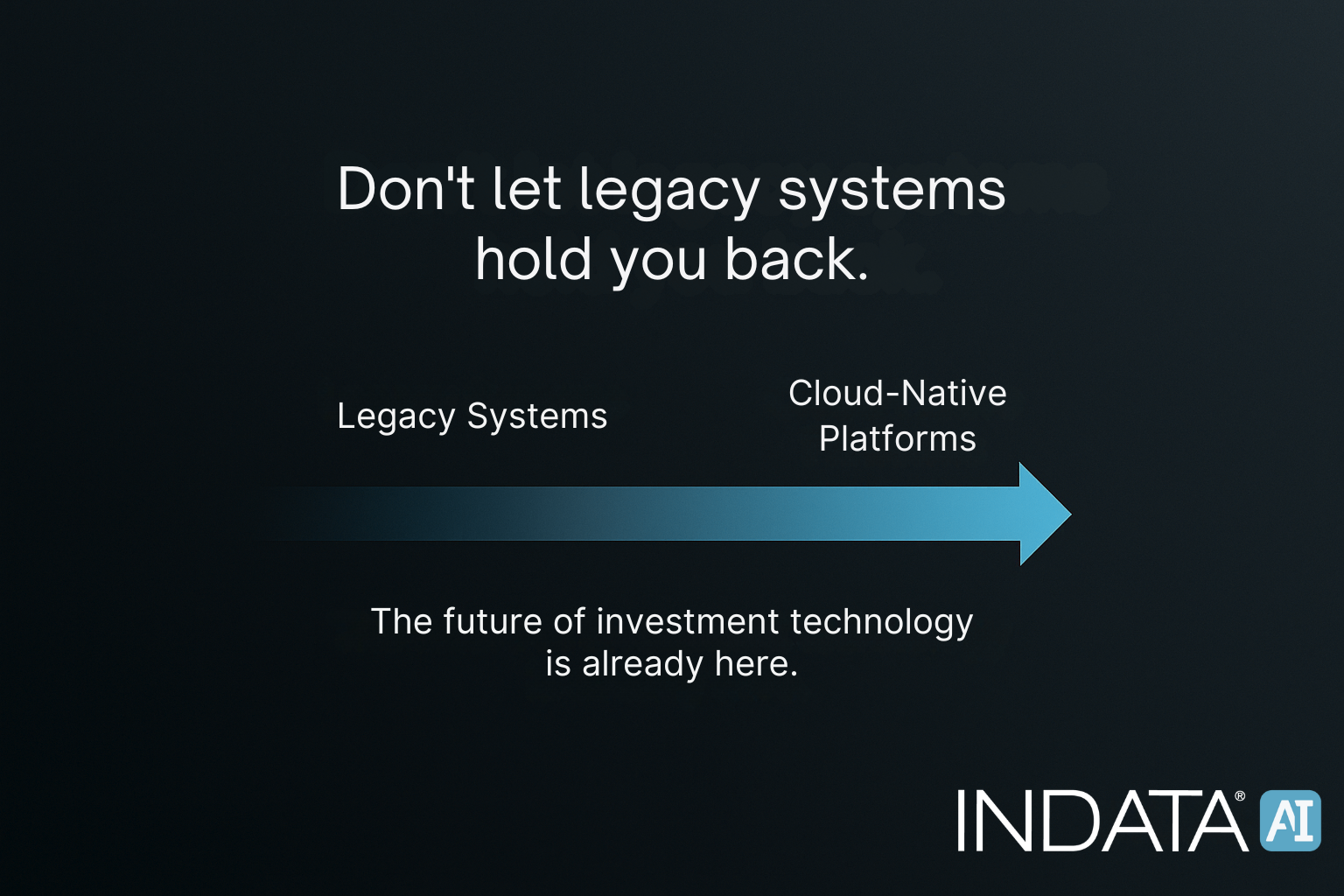
 Technology has been an enabler in investment firm operations, supporting all aspects of the trade lifecycle. Legacy systems, however, have incompatible architecture and a lack of open APIs (application programming interfaces). As a result, integrations and automation are difficult to achieve. Modern trade order management systems eliminate these challenges.
With firms still struggling to optimize their tech stacks fully, they must contend with obstacles. Slow trading operations, inefficiencies, and growth barriers hold organizations back. The key to overcoming these challenges is modernizing trading order management processes.
With a new approach to technology-powered solutions, firms can remove the limitations of legacy systems, minimizing friction and optimizing results.
The Limitations of Legacy Trade Order Management Systems
Legacy trade order management systems face problems that impede firm productivity and growth. These outdated platforms often fail to integrate with modern technologies and lack the robust architecture required for today’s fast-paced investment environment.
The drawbacks of legacy trade order management software include:
- Higher security risks: Legacy systems are often vulnerable to the point of failure and may no longer receive support or system updates from vendors. This leaves sensitive data exposed and increases the risk of breaches. Without an active platform, firms may also encounter issues with compliance.
- Lack of integration capabilities: Effective trade order management solutions require systems to communicate seamlessly with other parts of the technology ecosystem. Legacy platforms often struggle with integration, leading to operational silos and data inconsistencies. It’s mainly due to their inability to create open APIs. They may be able to use asynchronous APIs, but those are fraught with issues, including an inability to provide real-time responses. The results can be unreliable. Also, these types of APIs can only request information and wait for a response.
- Data silos: Valuable data trapped within legacy systems is not easily shareable with other applications, limiting its utility in driving the implementation of investment decisions.
- Excessive manual work: Outdated systems demand more manual intervention. This slows processes and increases the likelihood of human error and inefficiency.
Investment firms want to stay ahead in digital transformation. Failure to modernize could frustrate employees and impede client growth. It can put investment firms in a less advantageous position compared to competitors.
The Challenges of Legacy Trade Order Management Systems
In addition to limitations, further problems arise when organizations are stuck with legacy systems. Those include:
- Scalability issues: As investment firms grow and the data they need becomes more voluminous, older systems can’t handle it adequately, which could lead to downtime or performance bottlenecks.
- Slow to adapt: Legacy solutions may be unable to react to evolving business requirements. Technology vendors may not be investing in updating and improving these platforms, leaving firms behind in innovation, such as the embedding of AI tools.
- Higher costs: Legacy platforms may not have a SaaS option that’s hosted in the cloud. On-premises may be the only configuration in these circumstances, which requires a higher budget for management and upkeep.
- Increased security risks: Outdated systems may not have modern capabilities, which means they may be more vulnerable to hacking. Without consistent patches from vendors, organizations encounter heightened security risks.
- Lack of real-time data: Firms that can access and act on real-time data have a performance edge, but legacy systems often prevent this because they rely on batch processing, which means information could be stale.
The challenges and limitations of legacy systems stifle growth, making modernization a critical initiative. Moving forward, firms must prioritize trade order management systems asset management.
Why Modern Trade Order Management Systems Are Essential for Success
Modernizing trade order management systems is no longer optional. It’s crucial for staying competitive and enhancing trading and operational efficiency. Doing so also enables data-driven investment decision-making.
Investment firms should prioritize solutions that offer flexibility, scalability, and advanced features. It should be cloud-native (browser-based) and a SaaS (Software as a Service) model that combines trade order management (OMS) and portfolio management into a unified platform.
Upgrading trade order management software ensures organizations can future-proof systems. Continuous improvement and adaptation bring new functionality, including smarter automation and machine learning analysis. The path to success involves these modern features.
Features of Modern Trade Order Management Software
Beyond centralizing OMS/Portfolio Management, examples of trade order management system features include the following:
- Complete trade order management using either a full Investment Book of Record (IBOR)
- Real-time compliance across pre-trade, post-trade, and in real-time
- Advanced blotter functionality for quick order execution
- AI-enhanced portfolio modelling and rebalancing using sophisticated technology for more precise outcomes
- Customizable dashboards
- Regulatory reporting capabilities that provide event-driven audit trails
- Business intelligence (BI) reporting to drive meaningful decision-making
- Practical AI automation tools to manage complex workflows, analyze data, and reduce repetitive work, including natural language processing (NLP) and machine learning algorithms
How to Transition from Legacy Systems to Modern TOMS Solutions
How can organizations transition without considerable disruption? Any migration involves lots of work, but firms can avoid friction by taking these steps.
- Assess the legacy system and document its architecture, dependencies, and business relevance.
- Note any risks that could occur during the transition relating to data (e.g., exposure or loss).
- Define the firm’s long-term objectives for technology use to detail a roadmap for modernization.
- Create a project plan with the new software provider that notes roles, responsibilities, and timelines.
- Determine what data from the legacy system should migrate to the new one and how that will work. This is a good time to organize it and remove duplicates or outdated information. Then, all data from the system can be exported and stored securely.
- Begin the migration and completely replace the legacy system. Decommission the legacy system. After all necessary information leaves the old solution, sunset it completely.
- Test and validate after the migration to ensure the new system. It’s also a good time to evaluate any new integrations and workflows.
Benefits of a Modern Trade Order Management Solution
Firms can achieve many benefits by migrating to software that delivers what they need now and in the future.
When updating, expect to realize these advantages.
- Reduced IT maintenance: Internal teams no longer have to maintain investment management software. Updates and patches happen automatically.
- Holistic visibility: Users gain a holistic view across all trading and portfolio management tasks.
- Stronger security: The web-based system should reside in a private cloud with layers of security measures.
- Automation eliminates manual work: Automation streamlines processes and reduces the chances of human error.
- Enhanced AI capabilities: By integrating AI into the new system, users can gain valuable insights, identify patterns, and respond proactively to emerging trends.
- Seamless integrations: Open APIs make integrations easy. Modern software can easily connect with other applications using APIs.
Choosing the Right Trade Order Management System
When choosing a new platform, investment firms should evaluate options based on many attributes. Those include flexibility, scalability, features, security and compliance provisions, and the system’s ability to adapt.
Additionally, seek out solutions that integrate seamlessly with existing applications and those with responsive support and dedicated onboarding for the transition.
Another consideration is whether the platform can scale to meet future growth and adjust to ongoing market demands. In the end, the right solution should optimize operational efficiency and strengthen security while ensuring firms remain competitive in an ever-evolving financial landscape.
Future-Proof Your Trade Order Management System with INDATA
The time to modernize is now. INDATA offers a comprehensive, innovative solution designed to streamline management of trade orders, mitigate operational risks, and improve efficiency. With advanced AI features and seamless integrations, INDATA is the ideal partner for firms seeking to future-proof their operations.
See how the system works and why it’s a top choice for firms by requesting a demo today.
FAQs – Frequently Asked Questions
How does a trade order management system work?
These platforms automate and centralize the lifecycle of a trade. It involves order creation, execution, reporting, and compliance. The INDATA TOMS incorporates both an order management system (OMS) and an execution management system (EMS).
What is trade order management?
Trade order management refers to the process of handling trades and the technology that guides it. Trade order management includes the entire lifecycle of buy and sell orders, delivering a streamlined workflow from creation to execution. Many tasks make up these processes, including compliance checks, data aggregation, and connecting to trading venues.
What are the challenges of using legacy trade order management systems?
Firms can encounter numerous challenges when they are stuck with legacy systems. The primary ones are an inability to scale, being more vulnerable to cyberattacks, data living in siloes, inefficiencies due to too much manual work, an inability to integrate, and higher costs.
Why should firms modernize their trade order management systems?
Organizations modernizing their platforms can reap many benefits. Firms can quickly realize cost savings by moving from on-premises to the cloud. An updated solution also provides more visibility across the firm, strengthens security of data, and enables more automation.
A next-generation solution also incorporates the latest technology, such as AI tools. Open APIs, which legacy systems often lack, make connecting all systems easier, allowing firms to be more competitive and improve their performance.
How can firms transition from a legacy system to a modern Trade Order Management solution?
The process starts with finding the right technology partner with experience in migrations and dedicated to onboarding. Firms should work with their provider to detail a project plan that reviews all the dependencies and tasks required, such as moving data from the old system to the new one.
How does INDATA help modernize Trade Order Management systems?
INDATA has many modern capabilities. First, there’s the combination of OMS and EMS into one system, which streamlines the entire process. Second, the solution’s architecture is modern and agile, with open APIs to enable integrations. Third, it’s scalable, growing and retracting as needed since it lives in the cloud. Fourth, the INDATA platform includes practical AI tools to support analysis, automation, and more.
What are legacy trade order management systems?
The descriptor “legacy” in terms of these platforms means they are not built on modern architecture. Their coding and infrastructure are decades old. One of the key differences is also their lack of open APIs, which means integrations and data sharing have limitations.
Why is modernizing trade order management systems important?
A modern, future-proof tech stack for trade orders allows firms to be more efficient, accurate, and effective. Old technology puts firms in a position of always playing catch-up because their workflows are clunky and cumbersome. When organizations upgrade their systems, they realize considerable benefits, from streamlined processes to greater accuracy to being able to use insights actionably.
What are the challenges associated with legacy systems?
Legacy systems don’t connect easily with other platforms due to their outdated architecture and absence of open APIs. These older systems also have disjointed and inconsistent data issues, which impact accuracy. They are costly to maintain as many are only available as on-premises, which means firms must pay for equipment, maintenance, and resources. They also lack many modern features like AI tools.
How can INDATA help in modernizing the trade order management process?
The INDATA platform offers a solution that is agile and adaptable. That means as firms grow and mature, the software continues to support their work. INDATA’s reporting solution incorporates both order management and execution management into one system. Practical AI tools bring insights to the foreground faster, as well. Automation and integrations with other tools like business intelligence and compliance give firms everything they need to be competitive, effective, and efficient.
What features should a modern TOMS have?
The top capabilities to seek out when assessing options include complete trade order management, real-time compliance monitoring, customizable dashboards, advanced blotter functionality, AI tools to rebalance portfolios and power automation, and business intelligence tools.